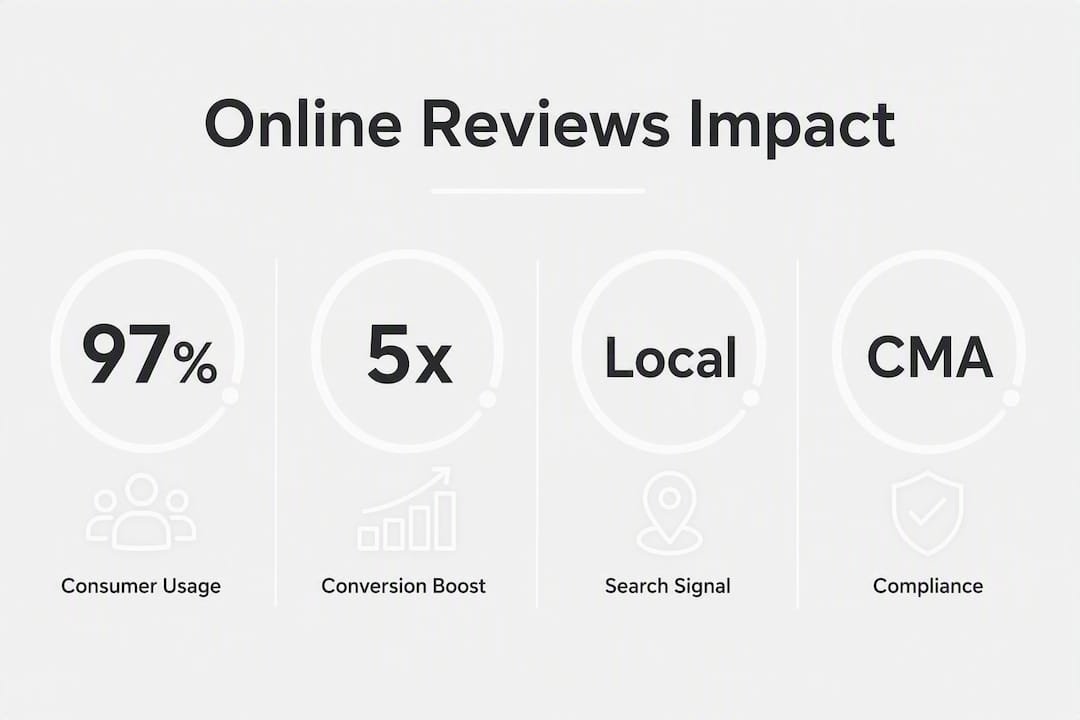
Online reviews are one of the fastest ways for a UK business to build trust, lift conversions and improve search visibility. According to BrightLocal, 97% of consumers use online reviews to guide purchasing decisions. Products with as few as five reviews see on average a 270% higher conversion rate compared with products without reviews. Businesses with a good star rating profile receive notably more clicks from local pack results.
The primary business outcomes you can expect from a well-run reviews programme are:
- Trust and credibility — social proof that reduces purchase hesitation
- Higher conversions — more enquiries and sales from the same traffic
- Local SEO visibility — stronger presence in Google’s map and local pack results
- Customer insight — real feedback that improves products, services and messaging
Table of Contents
- Why online reviews matter for customers and businesses alike
- How reviews shape your search rankings and local visibility
- How to collect more genuine reviews for your business
- How to respond to reviews and manage your reputation
- Risks and limitations you should know about
- What the research actually says: key statistics for UK businesses
- Key takeaways
- Reviews first: why it is the right starting point
- How Fyldedigital helps UK businesses build a reviews programme that works
- Useful sources
Why online reviews matter for customers and businesses alike
Reviews serve two distinct groups, and understanding both sides helps you build a programme that works for each.
For customers, reviews reduce the risk of a bad decision. Before spending money with a business they have never used, most people want evidence from someone who has. BrightLocal’s research shows that 34% of consumers act to purchase or book immediately after reading a positive review, while the remaining 66% carry out further research. Reviews accelerate that research phase considerably.
Nielsen-style findings cited by Mailchimp suggest a large majority of people view word-of-mouth as the most credible form of advertising. Online reviews function as a digital proxy for that peer recommendation, which is why they carry more weight than even well-crafted marketing copy.
For businesses, the benefits are measurable across several channels:
- Conversion rate lift — having several reviews on a product or service page can increase conversions significantly, according to the Spiegel Research Centre
- Local search visibility — Google Business Profile listings with strong review profiles appear more prominently in map and local pack results
- Organic SEO content — review text adds keyword-rich, user-generated content to your pages and Google Business Profile, feeding search algorithms with fresh signals
- Reduced acquisition cost — trust built through reviews means paid traffic converts at a higher rate, lowering your effective cost per lead
- Customer intelligence — recurring themes in feedback highlight service gaps, product issues and unmet expectations before they become serious problems
Platforms like Google Business Profile, Trustpilot and on-site review widgets each play a different role. Google Business Profile reviews feed directly into local search rankings and the knowledge panel. Trustpilot provides third-party credibility that carries weight on B2C and B2B purchase journeys. On-site reviews, displayed on product or service pages, support conversion at the moment a visitor is deciding whether to enquire.
How reviews shape your search rankings and local visibility
Review signals are now a confirmed component of Google’s local ranking algorithm. The key signals are rating score, review volume, recency, owner response rate and the relevance of review content to search queries.

Businesses with a good star rating profile receive notably more clicks from local pack results. That figure matters because local pack positions sit above organic results on most mobile searches, which is where the majority of local intent queries now originate. A business with 40 recent reviews and a 4.3-star rating will typically outperform a competitor with 8 older reviews and a 4.8-star rating, because recency and volume outweigh a marginally higher score.
Where reviews surface in search:
- Google Maps and local pack — the three-listing block that appears for “near me” and location-specific queries
- Google Business Profile knowledge panel — the sidebar card shown for branded searches
- Rich snippets in organic results — star ratings displayed beneath a page title in standard search results, driven by structured data on your website
- AI-generated search summaries — Google’s AI Overviews increasingly draw on review sentiment when summarising a business’s reputation
For a deeper look at how these signals connect to your overall local strategy, the local SEO strategy guide for UK businesses covers the full picture.
Pro Tip: Embed short, localised review excerpts on your key landing pages. A sentence like “Great service from the team in Blackpool — sorted our issue within 24 hours” adds geographic and topical relevance that generic copy cannot replicate, and it signals to Google that your page is genuinely relevant to local queries.
How to collect more genuine reviews for your business
A reviews programme does not need to be complicated, but it does need to be consistent. The businesses that accumulate the most reviews are not the ones with the happiest customers — they are the ones that ask, at the right moment, in the right way.
Step-by-step collection checklist
- Set up your Google Business Profile — claim and verify your listing before anything else. This is where most UK consumers will look first.
- Create a direct review link — Google provides a short URL from your Business Profile dashboard. Use this in every outreach message.
- Ask at the right moment — the optimal window is immediately after a service milestone: delivery confirmation, project completion, or a support resolution. Asking too early (before value is delivered) or too late (when the experience has faded) reduces response rates.
- Send a post-purchase email at day 3 — keep it brief. One sentence of thanks, one sentence asking for feedback, and a direct link. No lengthy preamble.
- Follow up at day 7 if no response — a single follow-up is acceptable. More than one risks irritating the customer and triggering the feedback-fatigue effect that NPR’s reporting has highlighted as a growing concern.
- Use SMS for service businesses — for trades, hospitality and healthcare, a text message at day 1 or 2 outperforms email in open rates.
- Add QR codes to printed materials — receipts, packaging, business cards and in-store signage can all carry a QR code that links directly to your review page. Fyldedigital’s print marketing services can help you produce these affordably.
- Use transactional links for verified-buyer badges — linking review requests to order confirmation emails or account logins allows platforms to display a verified-buyer indicator. Spiegel Research Centre findings confirm these badges improve conversion likelihood by signalling authenticity.
Timing guide
| Trigger | Channel | Timing | Ask style |
|---|---|---|---|
| Purchase / booking confirmed | Day 3 | Short, personal, direct link | |
| Service completed | SMS | Day 1–2 | One sentence, direct link |
| No response to first ask | Day 7 | Single follow-up only | |
| Repeat customer | — | Reference their history |
Platform priorities and CMA guidance
Prioritise Google Business Profile first — it has the most direct impact on local search. Add Trustpilot if you operate in a sector where third-party verification matters to buyers (finance, legal, e-commerce). On-site reviews suit product pages and service landing pages where conversion is the primary goal.
On incentivised reviews: the UK’s Competition and Markets Authority (CMA) is clear that offering rewards, discounts or gifts in exchange for positive reviews is unlawful. You may ask customers to leave a review, but the request must be neutral — not conditional on a positive outcome. Platforms including Google and Trustpilot have their own policies that mirror this position. Breaching these rules risks both platform penalties and regulatory action.
How to respond to reviews and manage your reputation
Responding to reviews is not optional. BrightLocal’s research identifies owner responses as a key trust signal, and Google’s own guidance confirms that responding professionally to negative feedback can rebuild trust and occasionally prompt customers to update their original review.

Response templates
Positive review:
Neutral review (3 stars, no specific complaint):
Negative review:
Suggested SLAs and triage rules
- Positive reviews — respond within 72 hours; a brief, genuine reply is sufficient
- Neutral reviews — respond within 48 hours; invite a direct conversation
- Negative reviews — respond within 24 hours; never argue publicly, always offer a resolution route
- Legal or safety concerns — do not respond publicly; escalate internally and seek legal advice before any reply
Once a negative review is resolved, follow up privately and invite the customer to update their review if they feel the outcome warrants it. Never ask them to remove it — that breaches platform terms.
Metrics to track
- Sentiment trend — use tools like Google Business Profile insights or Trustpilot’s dashboard to spot recurring themes
Risks and limitations you should know about
Reviews are powerful, but they are not a perfect signal. Understanding the limitations helps you manage expectations and avoid common mistakes.
Review bias is the most persistent problem. Customers who have had an extreme experience (very positive or very negative) are far more likely to leave a review than those who had an ordinary one. This means your rating reflects the outliers, not the average. A business with a 4.1-star average from 200 reviews is almost certainly more representative than one with a 5.0 average from 12.
The perfect score problem is worth noting. Spiegel Research Centre data shows that purchase likelihood often peaks in the 4.2–4.5 star range. A flawless 5.0 rating can appear suspicious to experienced buyers, because it implies either very few reviews or selective moderation.
Fake and manipulated reviews remain a genuine risk, both from competitors posting false negatives and from businesses inflating their own scores. Practical steps to manage this:
- Monitor your profiles weekly for sudden spikes in negative reviews from accounts with no review history
- Use Google’s “flag as inappropriate” function and Trustpilot’s reporting tools to challenge suspicious content
- Document your review acquisition process so you can demonstrate compliance if challenged by the CMA
Marginal returns diminish over time. The first five reviews drive the largest conversion gains: products with as few as five reviews see on average a 270% higher conversion rate compared with those without reviews. After roughly ten reviews, incremental benefit decreases for many products and services. This does not mean you should stop collecting reviews — recency matters for search signals — but it does mean the urgency of the first ten is higher than the urgency of reviews 50 through 60.
Time and cost are real considerations. Setting up a basic reviews programme (Google Business Profile, a review request email template, and a weekly monitoring routine) takes around 4–6 hours initially and roughly 1–2 hours per week to maintain at small-business scale. Adding Trustpilot or a third-party review platform increases that overhead. If you are managing reviews across multiple locations or product lines, the case for agency support becomes straightforward.
What the research actually says: key statistics for UK businesses
The evidence base for online reviews is strong, and the figures below are drawn from peer-reviewed research and established industry surveys.
97% of consumers use online reviews to guide purchasing decisions — BrightLocal Local Consumer Review Survey
| Statistic | Source | What it means for your business |
|---|---|---|
| 97% of consumers use reviews before buying | BrightLocal | Not having reviews is a visible gap that competitors will exploit |
| 270% higher conversion | Spiegel Research Centre | Getting your first five reviews is the single highest-ROI action |
| 25% more local pack clicks for 3–5 star profiles | WordStream | A strong rating directly increases free traffic from Google Maps |
| 34% of consumers buy immediately after a positive review | BrightLocal | Reviews drive direct purchase decisions, not just awareness |
| 83% of people trust word-of-mouth above advertising | Mailchimp / Nielsen | Reviews carry more persuasive weight than your own marketing copy |
For a broader view of how these signals connect to your local SEO importance and overall search performance, the research consistently points in the same direction: reviews are no longer a nice addition to a marketing plan. They are part of the infrastructure.
An action checklist based on these figures:
- Start with five — target five Google Business Profile reviews before anything else; the conversion lift is disproportionate at this threshold
- Maintain recency — aim for at least one new review per month to keep your profile active in search signals
- Respond to everything — owner responses are a confirmed trust signal and a local ranking factor
- Display reviews on-site — structured data markup on product and service pages can unlock rich snippets in organic results, increasing click-through rates
Key takeaways
Online reviews drive measurable gains in trust, conversions and local search visibility, making them one of the most cost-effective channels available to UK small and medium-sized businesses.
| Point | Details |
|---|---|
| Start with five reviews | having several reviews on a product or service page can increase conversions significantly |
| Respond within 24 hours | Owner response speed is a trust signal and a local ranking factor; negative reviews need a reply within 24 hours. |
| Prioritise Google Business Profile | Google reviews have the most direct impact on local pack visibility and map clicks for UK businesses. |
| Follow CMA guidance | Incentivising positive reviews is unlawful in the UK; keep all review requests neutral and platform-compliant. |
| Fyldedigital can help | Fyldedigital supports UK businesses with local SEO, review integration and web design to turn review signals into leads. |
Reviews first: why it is the right starting point
Most businesses treat reviews as a byproduct of good service. They are not wrong, but they are leaving a significant amount of value on the table. A customer who had a genuinely good experience will not automatically leave a review — they need to be asked, at the right moment, through the right channel. The businesses that understand this treat review acquisition as a process, not a hope.
What I find consistently underestimated is the connection between reviews and the rest of a digital marketing programme. A well-reviewed Google Business Profile does not just attract more clicks — it improves the quality of traffic arriving at your website, because visitors who have already seen social proof convert at a higher rate once they land. That means your web design, your SEO and your paid campaigns all perform better when your review profile is strong. They are not separate workstreams; they feed each other.
The other thing worth saying plainly: the businesses that wait until they have a “proper” marketing budget before starting a reviews programme are making a mistake. The first five reviews are the most valuable you will ever collect, and they cost nothing except the discipline to ask. Start there, build the habit, and the rest follows.
How Fyldedigital helps UK businesses build a reviews programme that works
Building a reviews programme from scratch takes time, and maintaining it consistently takes discipline. Fyldedigital works with UK small and medium-sized businesses to set up the full picture: Google Business Profile optimisation, on-site review integration, structured data markup for rich snippets, and review acquisition campaigns that stay within CMA guidelines.
The practical difference is that reviews do not sit in isolation. When Fyldedigital builds or redesigns a website, review content is built into the page structure from the start, not bolted on afterwards. Service pages carry verified testimonials. Product pages are set up for structured data. The result is a site that converts better from day one, because the trust signals are already in place.
If you want to see where your current setup stands, a free SEO review is a practical first step. Alternatively, if your website needs updating to display reviews properly, the web design service covers everything from initial build to review widget integration. Get in touch with Fyldedigital to discuss what a reviews-first approach would look like for your business.
Useful sources
- Local Consumer Review Survey — BrightLocal — the most widely cited annual survey of consumer review behaviour in the UK and US; provides the 97% and 34% figures used in this article.
- How Online Reviews Impact Your Business — WordStream — source for the 25% local pack click uplift figure and practical paid-search context.
- Google Business Profile: How to Respond to Reviews — Google’s own guidance on response best practice and the trust signals owner replies create.
- What Makes an Online Review Credible? — Management Review Quarterly (Springer) — academic synthesis of the five antecedent groups that determine whether a review is trusted or discounted.
- Research: What Consumers Find Persuasive in Online Reviews — Harvard Business Review — 2025 research on the specific content characteristics that make reviews more persuasive to buyers.
- Trustpilot — the leading third-party review platform for UK businesses; useful for sectors where independent verification carries particular weight with buyers.