Targeted SEO is the practice of focusing your digital presence on high-intent keywords and content that matches precisely what your ideal customers are searching for. Unlike broad SEO, which chases traffic volume, targeted SEO attracts visitors who are ready to enquire, book, or buy. Businesses implementing targeted SEO see quality leads and better conversion rates typically within 2–3 months. That speed matters when you are running a small or medium-sized business with limited marketing budget. Fyldedigital works with SMBs across the Fylde Coast to build exactly this kind of precision-led organic presence, and the results speak for themselves.
Why use targeted SEO instead of traditional SEO?
Targeted SEO is a move from broad keyword volume to precision-driven growth, focusing on high-intent search terms that convert better. Traditional SEO often chases high-volume keywords regardless of whether the searcher is ready to act. A plumber ranking for “plumbing” attracts researchers, students, and competitors. A plumber ranking for “emergency boiler repair Blackpool” attracts someone with a burst pipe and a credit card in hand.
The difference comes down to buyer intent. Targeted SEO maps your content to where your customer is in their decision journey: awareness, consideration, or decision. Each stage requires different content and different keywords. A blog post answering “what causes a boiler to lose pressure” serves the awareness stage. A page titled “boiler repair Blackpool: same-day service” serves the decision stage.

Broad SEO also struggles in 2026 because AI-powered search engines now reward precision. Segment-led SEO is essential to gaining authoritative AI answer citations and featured snippets. Search engines like Google increasingly surface content that answers a specific question completely, rather than content that simply mentions a keyword many times.
The core mechanics of targeted SEO include:
- Audience segmentation by demographics, behaviour, and buying stage
- Keyword clustering around specific problems your audience wants solved
- Content mapped to intent, not just search volume
- On-page signals that confirm relevance to a narrow, defined topic
- Internal linking that guides visitors toward conversion pages
Each of these elements works together. Miss one, and the precision breaks down.
What are the key benefits of targeted SEO for small businesses?
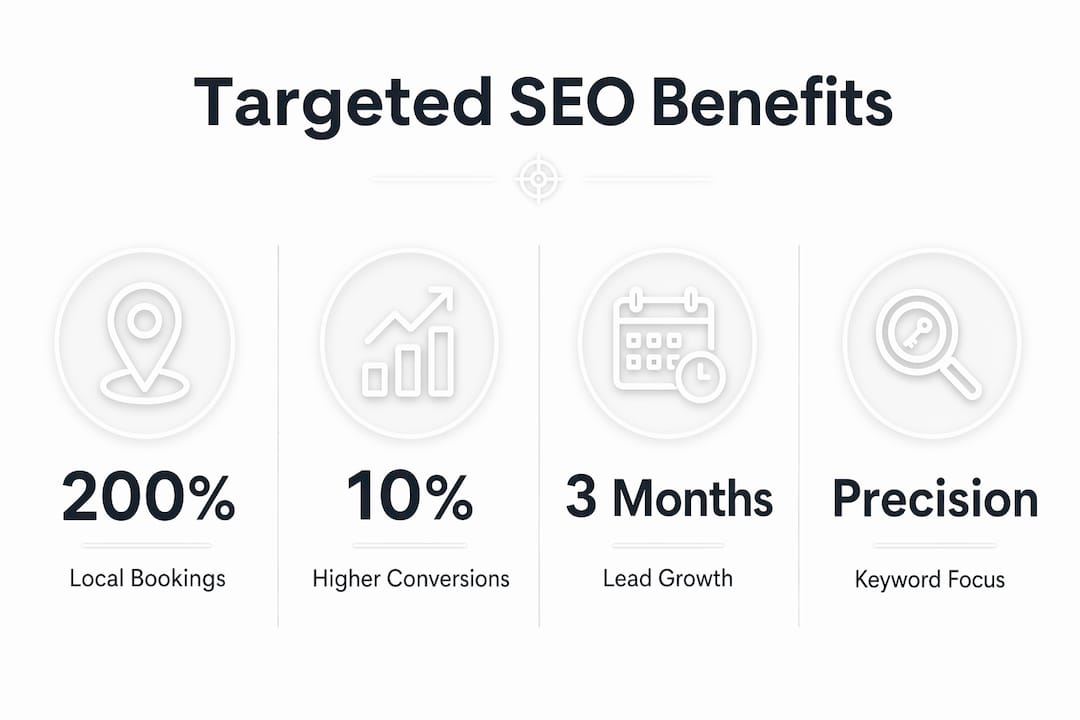
The primary benefit of targeted SEO is higher quality leads. Targeted SEO reduces wasted spend by bringing highly qualified visitors with clear intent who are ready to engage or purchase. That means your enquiry form gets filled in by people who actually need your service, not people who stumbled onto your site by accident.
The measurable advantages stack up quickly:
- Higher conversion rates. Visitors arriving via intent-matched keywords convert at a significantly higher rate than general organic traffic, because the content they land on directly answers their question.
- Better engagement metrics. Pages built around specific intent keep visitors reading longer, which reduces bounce rates and signals quality to Google.
- Improved SERP visibility. Formatting title tags as questions can increase average click-through rates by 14.1%. That is a meaningful gain from a single on-page adjustment.
- Stronger ROI. When your traffic is qualified, every pound spent on content creation and technical SEO goes further. You are not paying to attract people who will never buy.
- Long-term topical authority. Publishing content consistently around a defined topic cluster builds authority signals that compound over time, making it progressively harder for competitors to displace you.
Local businesses using geo-specific long-tail targeting have reported up to 200% increases in service bookings. That figure reflects what happens when keyword precision meets genuine local demand. The traffic volume may be lower than a broad campaign, but the proportion of visitors who convert is far higher.
Pro Tip: Track conversions, not just traffic. A page with 200 monthly visitors and a 10% conversion rate outperforms a page with 2,000 visitors and a 0.5% conversion rate every single time.
How to implement targeted SEO strategies effectively
Effective implementation starts with knowing exactly who you are trying to reach. Audience segmentation is the foundation. Define your customer groups by what they need, how they search, and where they are in their buying journey. A solicitor might segment by “first-time homebuyers,” “business owners needing contracts,” and “individuals facing employment disputes.” Each group searches differently and needs different content.
Once you have your segments, map keywords to each buyer stage. Use keyword difficulty as a practical filter: a keyword difficulty score below 30% is generally considered easy to rank for, 30–40% is intermediate, and above 40% is difficult. For most SMBs, targeting keywords in the easy to intermediate range delivers faster results with less competition.
Content planning follows keyword mapping. Each piece of content should answer one specific question for one specific audience segment. Writing content to answer user next steps aligned to buyer stage leads to better conversion than keyword stuffing. A decision-stage page needs a clear call to action. An awareness-stage blog post needs a link to a related consideration-stage guide.
Internal linking ties everything together. Intent-matched anchor text boosts conversions by signalling to both search engines and users where to find conversion pages. Link from your informational content to your service pages using anchor text that reflects what the visitor is looking for, not generic phrases like “click here.”
Key implementation steps:
- Build audience personas before writing a single word of content
- Assign each keyword to a specific buyer stage and page
- Write one page per intent, not one page covering everything
- Use question-based title tags to improve click-through rates
- Link every informational page to at least one conversion-focused page
- Review SEO best practices regularly as search algorithms evolve
Pro Tip: Use Google Search Console to identify which of your existing pages already attract intent-rich queries. Optimising those pages first delivers results faster than building new content from scratch.
Common pitfalls in targeted SEO and how to avoid them
The most damaging mistake in targeted SEO is ignoring content that already exists. Pages can lose 50% or more traffic over 6–12 months without updates. Refreshing a declining page almost always delivers higher ROI than writing a new one, because the page already has backlinks, indexing history, and some authority. Audit your content every six months and update anything that has dropped significantly in traffic or rankings.
Keyword stuffing is the second most common error. Repeating a keyword phrase throughout a page without matching the actual intent behind it confuses both search engines and readers. Google’s algorithms in 2026 are sophisticated enough to recognise when content is written for rankings rather than for people. Write for the reader first. If your content genuinely answers their question, the rankings follow.
Other pitfalls to watch for:
- Ignoring audience segments. Publishing generic content that speaks to no one in particular means it converts no one in particular. Every page needs a defined reader.
- Missing calls to action. Clear calls to action and intent-matched content separate leads from casual page viewers. If a visitor reads your page and does not know what to do next, you have lost them.
- Measuring traffic instead of conversions. Traffic is a vanity metric if it does not convert. Set up goal tracking in Google Analytics and measure what actually matters to your business.
If your current SEO efforts are not producing enquiries, the reasons SEO fails are almost always rooted in one of these pitfalls. Fixing them does not require starting over. It requires auditing what you have and aligning it to intent.
Key takeaways
Targeted SEO outperforms broad SEO because it attracts visitors with clear buying intent, which converts more efficiently and delivers stronger return on every pound invested.
| Point | Details |
|---|---|
| Intent beats volume | Targeting high-intent, low-competition keywords delivers more conversions than chasing high-traffic broad terms. |
| Segmentation is the foundation | Map audience groups to specific keyword clusters before creating any content. |
| Content rot costs rankings | Audit existing pages every six months and refresh declining content before creating new pages. |
| Internal linking drives conversions | Use intent-matched anchor text to connect informational pages to your service and conversion pages. |
| Measure conversions, not traffic | Set up goal tracking and evaluate SEO performance by leads and enquiries, not visitor numbers alone. |
The shift I have seen that most SMBs miss
The businesses I see struggling with SEO in 2026 are almost always making the same mistake. They are publishing content, ticking boxes, and watching traffic numbers. But they are not asking the one question that matters: “Does this page serve someone who is ready to buy from me?”
I have worked with SMBs who had dozens of blog posts and almost no enquiries. When we audited their content, the pattern was clear. Every post targeted broad, informational keywords that attracted curious readers, not potential customers. The fix was not to write more content. It was to map what already existed to buyer stages, add clear next steps, and build internal links toward the service pages.
The other shift worth noting is the role of AI in search. Generative search engines now pull answers directly from pages that are structured clearly and written for a specific question. If your content is vague or tries to cover too many topics at once, it will not get cited. Precision is now a ranking signal in its own right.
My honest advice: stop measuring success by how much content you publish. Measure it by how many of your pages have a defined audience, a clear intent match, and a conversion path. That is the difference between choosing an SEO agency that delivers results and one that delivers reports.
— tibor
Fyldedigital’s targeted SEO services for SMB growth
Fyldedigital specialises in targeted SEO campaigns built around audience segmentation, keyword strategy, and content that converts. Whether you run a local trade business, a professional services firm, or a retail operation, the approach is the same: identify who your best customers are, find out how they search, and put the right content in front of them at the right moment.
Every campaign Fyldedigital builds starts with a free SEO review, so you know exactly where your current visibility stands before any work begins. From keyword mapping to on-page optimisation and internal linking, the full process is covered. Explore targeted SEO strategies that are built for businesses your size, or read the SMB SEO strategy guide to see the full picture before you commit.
FAQ
What is targeted SEO?
Targeted SEO is the practice of focusing your website content on specific, high-intent keywords that match what your ideal customers are actively searching for, rather than pursuing broad traffic volume.
How quickly does targeted SEO show results?
Businesses implementing targeted SEO typically see improvements in lead quality and conversion rates within 2–3 months, even when overall traffic growth is gradual.
Why does targeted SEO produce better leads than general SEO?
Targeted SEO attracts visitors with clear buying intent, which means they are more likely to enquire or purchase. General SEO often brings unqualified traffic that does not convert, wasting marketing spend.
How does audience segmentation improve SEO performance?
Segmenting your audience allows you to map specific keyword clusters to defined customer groups, improving content relevance, reducing wasted spend, and increasing the proportion of visitors who convert.
What is content rot and why does it matter for targeted SEO?
Content rot occurs when pages lose traffic over time due to outdated information or declining relevance. Pages can lose more than 50% of their traffic within 6–12 months without updates, which directly reduces conversions.
Recommended
- SEO Growth Case Study: What Actually Works – Fylde Digital – Web Design SEO Social Media
- SEO Review for Small Business That Drives Growth – Fylde Digital – Web Design SEO Social Media
- Examples of SEO strategies for small businesses
- SEO vs PPC: Which One Grows Your Business? – Fylde Digital – Web Design SEO Social Media