Your website is often the first salesperson your business ever has. Before a prospect picks up the phone or visits your shop, they’ve already formed an opinion based on what they see online. 75% of users judge a company’s credibility based on its website design alone. That’s not a small statistic. It means your design choices are actively winning or losing you business every single day. This article covers what effective web design actually means, why it matters far beyond aesthetics, and how you can apply the right principles to drive real results for your business.
Table of Contents
- Why web design matters for your business
- Core principles of effective web design
- The web design process: From goals to launch
- Accessibility and edge cases: Including everyone
- Web design for ROI: Conversions over appearances
- The hard truth most guides miss about web design
- Take the next step to transform your web presence
- Frequently asked questions
Key Takeaways
| Point | Details |
|---|---|
| Trust comes first | Your website’s design is your first chance to build credibility with customers. |
| Prioritise user experience | Mobile-friendly, accessible sites outperform those focused only on looks. |
| Conversion is key | Clear calls to action and fast load times turn visitors into buyers. |
| Accessibility benefits all | Improving website accessibility supports users, boosts reputation, and avoids legal trouble. |
| Web design is ongoing | Treat web design as a continual improvement for sustained business results. |
Why web design matters for your business
Many business owners treat their website as a digital brochure. Something to tick off the list, update once, and then leave alone. But that approach costs you more than you realise. Your website works around the clock, and every visitor is making a judgement call about whether to trust you within seconds of landing on your page.
Research consistently shows that credibility judgements are based primarily on visual design, not content. Visitors don’t read your page first. They see it. A cluttered layout, slow load time, or inconsistent branding sends a clear signal: this business isn’t professional. And once that impression is formed, it’s very difficult to recover.
“Your website is the only salesperson who never sleeps. Make sure it’s saying the right things.”
Understanding the lasting value of custom web design is a good starting point if you’re questioning whether to invest properly in your site. The short answer is: poor design doesn’t just look bad, it loses you leads. Effective design, on the other hand, delivers several compounding business benefits:
- Credibility: A well-designed site tells visitors you’re legitimate and trustworthy.
- Trust: Consistent branding, clear messaging, and professional visuals build confidence.
- Conversion: Intuitive layouts guide visitors towards enquiries, purchases, or bookings.
- Brand consistency: Your website should reflect the same quality you deliver in person.
Our guide to business website design explores these themes in depth, but the core point is simple. Design is not decoration. It’s a business function.
Core principles of effective web design
Understanding the foundations of good web design helps you make better decisions, whether you’re briefing an agency or reviewing your current site. These principles aren’t optional extras. They’re the standard that modern customers expect.

| Principle | What it means | What it delivers |
|---|---|---|
| Mobile-first design | Built for smartphones first, then scaled up | Better experience for the majority of visitors |
| Visual hierarchy | Guiding the eye using size, colour, and layout | Visitors find what they need faster |
| Whitespace | Generous spacing between elements | Cleaner, more professional appearance |
| Accessibility | Meeting WCAG contrast and usability standards | Inclusive experience for all users |
| SEO integration | Structuring the site for search engines from day one | Improved organic visibility and traffic |
| User-centred design | Building around user needs and behaviours | Higher engagement and lower bounce rates |
These aren’t abstract concepts. Modern web design essentials include mobile-first responsive layouts using flexible grids and CSS media queries, typographic scale, accessibility standards including a 4.5:1 colour contrast ratio, and SEO integration built into the design phase, not bolted on afterwards. Each element plays a practical role in how your site performs.
Improving your website user experience is closely tied to these principles. When navigation is clear, content is easy to scan, and pages load quickly, visitors stay longer and act more often. That directly increases your chances of converting a visitor into a customer.
Applying SEO best practices from the start means your site structure, page headings, image descriptions, and internal linking all support your visibility in search engines, rather than working against it.
Pro Tip: Don’t let visual flair distract from clarity. The most effective websites are the ones where visitors instantly know what to do next. Prioritise clear calls to action over elaborate animations or complex layouts.
A few additional design behaviours worth building into your site from the start:
- Use consistent fonts and colours across all pages
- Make your phone number and contact details easy to find on every page
- Ensure your logo links back to the homepage
- Write button text that tells people exactly what happens when they click
The web design process: From goals to launch
Knowing the principles is one thing. Applying them in a structured way is another. Whether you’re building a new site or considering a redesign, following a clear process reduces costly mistakes and ensures your site actually serves your business goals.
Here’s a practical sequence to follow:
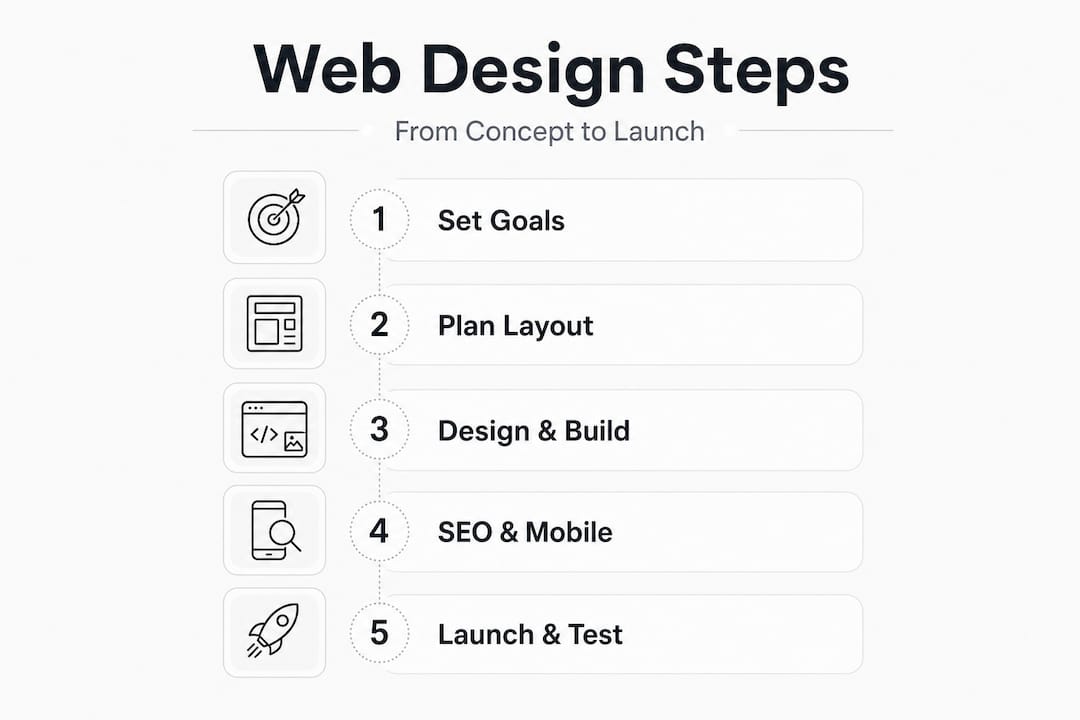
- Define your goals and KPIs. What do you want visitors to do? Call you, fill in a form, buy a product? Clarity here shapes every decision that follows.
- Map your site structure. Create a sitemap that covers all the pages you need and how they connect. Think about what your customers need to find, not just what you want to tell them.
- Build wireframes. These are basic blueprints of each page showing layout, not design. They help you focus on structure and flow before colour or imagery is introduced.
- Design with the user at the centre. Every layout decision should ask: does this make it easier for my visitor to take action? Place CTAs prominently and logically.
- Test mobile performance. Mobile page speed below a 2.5-second Largest Contentful Paint (LCP) is now essential. Slow sites lose visitors before they even see your offer.
- Launch with confidence. Check all links, forms, and pages on multiple devices before going live. A broken contact form on launch day is a costly error.
- Set up post-launch analytics. Use tools like Google Analytics to measure what’s working and what isn’t.
“The goal isn’t a beautiful website. The goal is a website that grows your business. Measure the results, not the aesthetics.”
The process of creating a converting business website always comes back to this: your site should be built around results, not opinions. A website redesign for SEO growth can dramatically improve your visibility if done with strategy rather than style alone. Post-launch, tracking and analysing user behaviour gives you the data to keep improving.
Accessibility and edge cases: Including everyone
This is the area most businesses overlook, and it’s becoming increasingly important both legally and commercially. Accessibility means designing your site so that people with visual, motor, or cognitive impairments can use it. But it also means catering for users on slow connections, older devices, or with less common input methods.
The numbers here are stark. 94.8% of websites fail basic accessibility checks. That’s not just an ethical issue. It’s a legal exposure and a missed opportunity to serve a wider audience.
Here’s a comparison of what inclusive versus exclusive design looks like in practice:
| Feature | Inclusive design | Exclusive design |
|---|---|---|
| Images | Alt text describing content | No alt text, invisible to screen readers |
| Colour contrast | 4.5:1 ratio minimum | Low contrast, hard to read in sunlight |
| Navigation | Keyboard-friendly, logical tab order | Mouse-only, no keyboard access |
| Forms | Clear labels and error messages | Unlabelled fields, confusing errors |
| Mobile responsiveness | Adapts to all screen sizes | Fixed layout, broken on small screens |
| Load speed | Optimised for slow connections | Heavy files, fails on limited data |
Explore Fylde Digital’s web accessibility services to understand how professional design integrates these standards from the ground up rather than patching them in later.
Pro Tip: Designing for accessibility improves the experience for everyone, not just users with disabilities. Better contrast helps people reading in bright sunlight. Clear navigation helps older users. Faster load times help anyone on a mobile connection.
Some quick steps you can take to improve accessibility right now:
- Add descriptive alt text to every image on your site
- Check your colour contrast using a free tool like WebAIM Contrast Checker
- Make sure all forms have visible, clear labels
- Test your site on a mobile device with a slow connection
- Try navigating your site using only a keyboard, without a mouse
Web design for ROI: Conversions over appearances
Here’s the practical truth: a website that looks stunning but doesn’t convert is an expensive piece of art. Your return on investment comes from what your visitors do, not from how impressed they are by the design.
The elements that genuinely drive website ROI are clear calls to action, trust signals, fast mobile performance, and accessibility. Visual flair comes a distant fifth. When you’re prioritising where to focus your design budget, rank your efforts like this:
- Clear, well-placed CTAs. Every page should have one primary action. Make it obvious, make it easy, and place it where visitors naturally look.
- Trust signals. Testimonials, case studies, logos of recognised clients or accreditations, and visible contact details all reduce hesitation.
- Mobile speed. A page that loads in under 2.5 seconds on a mobile connection keeps visitors. A slow page loses them before they see anything.
- Accessibility. A site that works for everyone is a site that converts more visitors, across more situations and devices.
- Visual design. Colour, imagery, and typography support the above. They shouldn’t lead the brief.
This ranking might feel counterintuitive if you’ve been told to focus on making your website look impressive. But the data supports it consistently. A well-structured, fast-loading, conversion-focused site will outperform a visually striking but confusing one every time.
Pro Tip: Test different CTA button text with small changes. “Get a free quote” often outperforms “Contact us” because it tells visitors exactly what they’ll receive. Small wording changes can produce noticeable differences in enquiry rates.
If you’re considering a redesign for better ROI, focus the brief on conversion outcomes rather than aesthetic preferences. Brief your agency on what you want visitors to do, and measure success by whether they do it.
The hard truth most guides miss about web design
Most articles on web design present it as a project with a beginning and an end. You build a site, you launch it, and you move on. That thinking is exactly why so many SME websites quietly underperform for years without anyone noticing.
The businesses that get the most from their websites treat design as a continuous investment. Customer expectations evolve. Devices change. Search engines update their algorithms. What performed well two years ago may now be slow, outdated, or no longer ranking. A site that isn’t actively maintained and improved starts losing ground the moment it goes live.
The most successful companies we work with don’t ask “how much does a website cost?” They ask “how much can our website generate, and what do we need to do to keep it generating?” That’s a fundamentally different question, and it leads to fundamentally better results.
Data is what separates the businesses that grow from those that stagnate. Instead of redesigning based on personal taste or what a competitor’s site looks like, the best approach is to review your analytics, identify where visitors drop off, test changes, and measure the outcome. Opinion is a starting point. Data is what drives progress.
If you want web design that drives business rather than just looking good on a screen, start treating your website the way you treat any other business tool. Budget for it, maintain it, and measure its performance consistently.
Take the next step to transform your web presence
Understanding these principles is the foundation. Applying them effectively is where expert support makes a real difference. A professional web design agency brings not just design skill, but strategic thinking, technical implementation, and ongoing performance monitoring to ensure your site keeps working hard for your business.
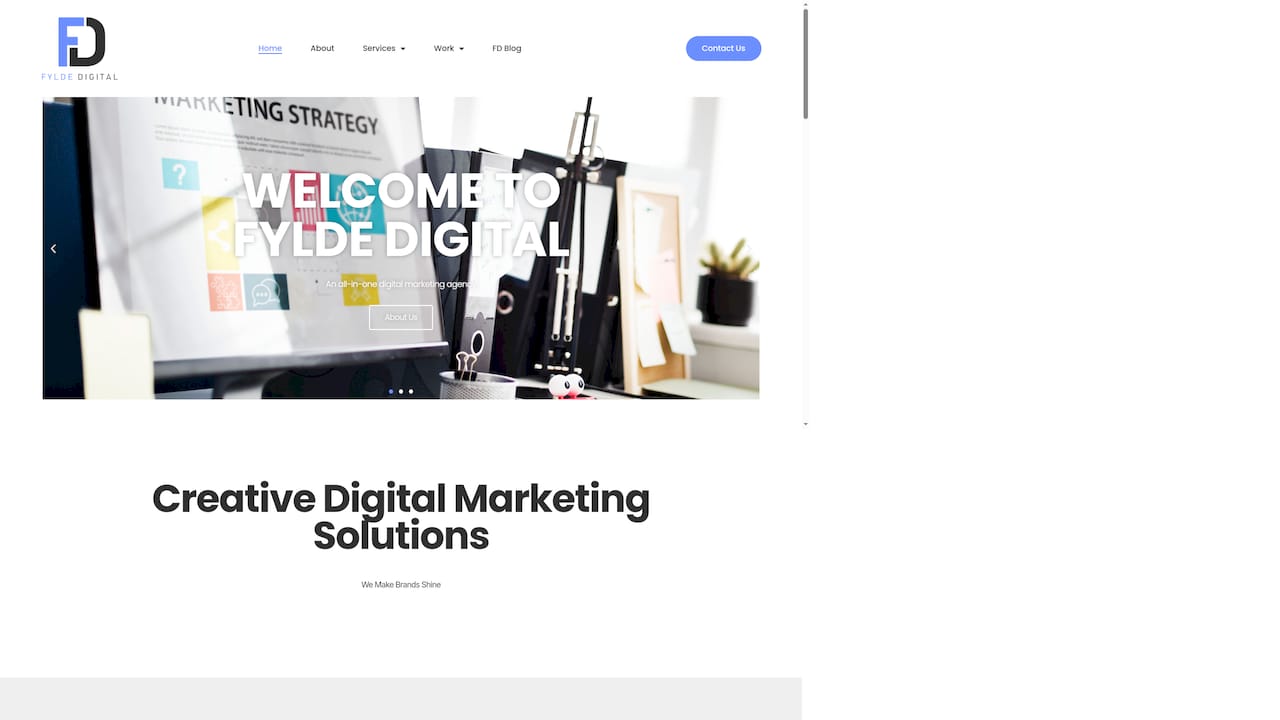
At Fylde Digital, we specialise in web design for SMEs that is built around your business goals, not just your preferences. From conversion-focused layouts to mobile-first builds and full SEO integration, we handle the detail so you can focus on running your business. If you want to go deeper on the foundations, our detailed web design guide is a practical resource to work through. And if you’re ready to make your site perform harder in search results, explore our SEO strategies alongside your design work for the strongest possible outcome.
Frequently asked questions
Why is responsive design important for small businesses?
Responsive design ensures your website works smoothly on any device. Mobile-first design using flexible grids and media queries is now the baseline expectation for any professional site.
How does web design affect search engine rankings?
Design choices like site speed, mobile-friendliness, and SEO from the design phase directly impact how well your business ranks, making it essential to integrate SEO considerations before a single page is built.
What are some quick wins to improve website accessibility?
Use high-contrast colours, add alt text to images, and test your site on mobile and older devices. With 94.8% of sites failing basic accessibility checks, even small improvements put you ahead of most competitors.
What is a call to action (CTA) and why does it matter?
A call to action guides visitors towards doing something valuable, such as making contact or purchasing. Clear CTAs are consistently one of the most important drivers of website ROI.
How often should a small business update its website design?
You should review your site at least once a year and refresh design elements to stay current with user expectations, device trends, and search engine standards. Regular, incremental improvements outperform infrequent major overhauls.