A digital footprint is the unique trail of data created by your online activities, both intentional and passive, that shapes how you are perceived by employers, customers, and algorithms alike. Every search query, social media post, website visit, and app login contributes to this record. For individuals, it affects reputation and privacy. For businesses, it determines brand credibility and cybersecurity exposure. Understanding your digital footprint is the first step towards controlling it.
What is a digital footprint and how does it form?
A digital footprint is defined as any traceable information about a person or organisation found online, encompassing both deliberate actions and data collected without direct input. Trend Micro describes it as including personal identifiers, locations visited, browsing patterns, and account activity. The concept is broader than most people realise. It is not simply what you post; it includes everything recorded about you as you move through the digital world.
It is worth distinguishing a digital footprint from a digital identity. Your digital identity is the intentional self-expression you craft online, the profile you build on LinkedIn or the brand voice you project on Instagram. Your digital footprint, by contrast, includes unintentional data collected passively, even when you have not actively shared anything. This distinction matters because managing your footprint requires addressing both what you choose to share and what is collected without your knowledge.

The footprint begins forming earlier than most people expect. BBC Teach notes that digital footprints start before a person even begins using a computer themselves, as parents share photos and schools record data. By the time someone enters the workforce, their footprint may span decades of accumulated data.
What are the different types of digital footprints?
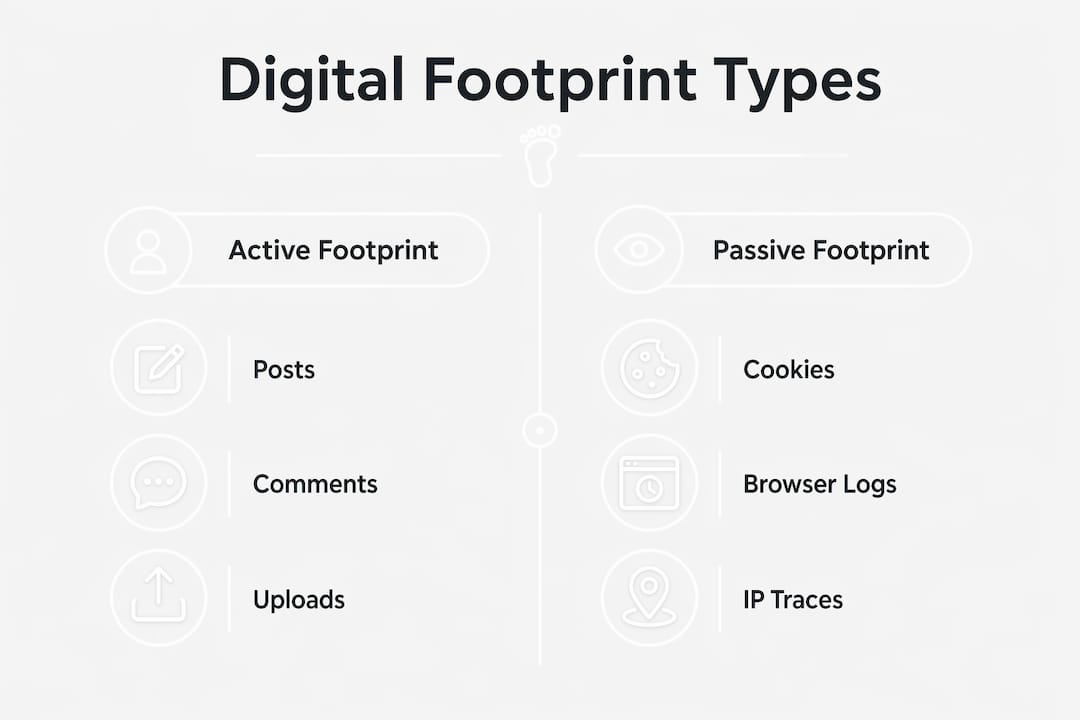
Digital footprints split into two distinct categories: active and passive. Understanding both is the foundation of any credible management strategy.
Active footprints are created when you deliberately share information online. Common examples include:
- Social media posts on platforms such as Facebook, Instagram, and LinkedIn
- Comments left on blogs, news articles, or forums
- Emails and messages sent through platforms like Gmail or WhatsApp
- Account registrations and profile creation on any website
- Uploads of photos, videos, or documents to cloud services
Passive footprints are generated without your direct action. Passive examples include web-browsing history, cookies, IP address logging, and device fingerprinting. When you visit a website, that site typically records your IP address, the browser you used, the time of your visit, and how long you stayed. You did not choose to share this. It was collected automatically.
The invisibility of passive footprints is what makes them genuinely risky. Most people accept cookie notices without reading them, granting websites permission to track behaviour across sessions and even across different sites. Advertisers, data brokers, and in some cases malicious actors can access this information.
Pro Tip: Review the privacy settings on Facebook, TikTok, and Instagram at least once every six months. Cybersecurity experts specifically recommend checking app permissions on these platforms to reduce exposure to phishing and identity theft.
How do digital footprints impact individuals and businesses?
The consequences of an unmanaged digital footprint are concrete and far-reaching. For individuals, the risks cluster around three areas: reputation, privacy, and security.
Employers and recruiters routinely search candidates online before making hiring decisions. A poorly considered post from years ago, an outdated profile with inconsistent information, or a pattern of aggressive comments can cost someone a job offer. The data does not expire. As BBC Teach confirms, footprints last indefinitely and may be accessed later for job checks or other opportunities. This permanence is what separates digital behaviour from a casual conversation.
For businesses, the stakes are higher still. Consider the following sequence of risks that an unmanaged organisational footprint creates:
- Employee data exposure. Staff members who use personal accounts for work tasks, or who share company information on public forums, create data trails that expose internal processes and sensitive information.
- Phishing and social engineering. Cybercriminals use publicly available footprint data to craft convincing phishing attacks. The more information visible about your team and operations, the easier it is to impersonate a trusted contact.
- Reputational damage. A single viral post, a negative review left unaddressed, or a data breach traced back to poor digital hygiene can undermine years of brand building.
- Regulatory exposure. Organisations operating under GDPR must account for the data they collect and store. An unaudited footprint may contain compliance gaps that carry financial penalties.
“Employees may unknowingly share sensitive information damaging organisational security.” — Trend Micro
This is not a theoretical risk. Unmanaged organisational footprints directly enable phishing campaigns and corporate cybersecurity compromise. Businesses that treat digital footprint management as an IT concern rather than a board-level priority are leaving themselves exposed. Understanding the impact of digital footprint on brand perception and customer trust is now a core part of modern marketing strategy.
How can you manage and reduce your digital footprint?
Effective management requires two separate tracks because active and passive footprints respond to different interventions.
Managing your active footprint
Active footprint control begins with a content audit. Search your own name on Google, Bing, and DuckDuckGo. Review every social media profile you have ever created, including dormant ones. Dormant accounts pose disproportionate security risks due to less frequent monitoring and outdated credentials. Deleting or securing these accounts is one of the highest-return actions you can take.
Removing content from search results is more complex than most people assume. Effective footprint reduction is a multi-step process: you must adjust privacy settings on the source platform, submit removal requests to search engines, and in some cases contact site owners directly. Removing a result from Google does not delete the original content. Each step requires separate action.
Managing your passive footprint
Passive footprint defence requires a different set of tools. The table below compares the most practical approaches:
| Approach | What it addresses | Practical tool or method |
|---|---|---|
| Browser privacy settings | Cookie tracking and session data | Firefox with Enhanced Tracking Protection, or Brave browser |
| VPN usage | IP address logging and location tracking | A reputable VPN service used consistently |
| App permission reviews | Data collected by mobile applications | iOS Privacy Report or Android Permission Manager |
| Opt-out from data brokers | Personal data held by third-party aggregators | Manual opt-out requests to brokers such as Acxiom or Whitepages |
| Device hardening before travel | Device-level traces at border crossings | Removing sensitive content from devices before international re-entry |
For businesses, digital footprint management must be embedded into cybersecurity policy. This means defining what employees can share publicly, establishing clear data governance rules, and conducting regular audits of company-owned digital assets including websites, social profiles, and third-party tool integrations.
Pro Tip: Use Fyldedigital’s SEO audit checklist as a starting point for reviewing your business’s online presence. It surfaces visibility gaps that often correspond to footprint risks.
What tools can help you monitor your online presence?
Tracking your online presence does not require specialist technical knowledge. Several tools make the process accessible for both individuals and business owners.
- Trend Micro’s Digital Footprint Overview scans publicly available data to show what information about you is visible online, covering social profiles, data broker listings, and exposed credentials.
- Google Alerts sends notifications whenever your name, brand, or specified keywords appear in new search results. It is free and takes under five minutes to configure.
- Fyldedigital’s social media management service provides businesses with structured oversight of their social content, ensuring that what is published aligns with brand values and does not create unintended exposure.
- HaveIBeenPwned checks whether your email address has appeared in known data breaches, which directly indicates passive footprint exposure.
- Privacy Badger (developed by the Electronic Frontier Foundation) blocks invisible trackers that build passive footprint profiles as you browse.
For businesses, a quarterly digital audit is the minimum standard. This should cover your website’s data collection practices, the social platforms your team uses for work-related activity, and any third-party tools with access to customer data. Reviewing key digital marketing metrics alongside your footprint audit gives you a clearer picture of how your online presence is performing and where it may be creating risk.
Key takeaways
A digital footprint is a permanent, multi-layered record of your online activity that requires active management across both intentional content and passively collected data to protect your reputation and security.
| Point | Details |
|---|---|
| Two distinct footprint types | Active footprints are deliberate; passive footprints are collected silently via cookies, IP logging, and device tracking. |
| Footprints are permanent | Data stored online can be accessed years later for employment checks, legal proceedings, or targeted advertising. |
| Businesses face specific risks | Unmanaged employee data trails enable phishing attacks and create regulatory exposure under frameworks like GDPR. |
| Removal is multi-step | Deleting content from search results requires action at the source, with search engines, and with site owners separately. |
| Dormant accounts are high risk | Old, unmonitored accounts carry outdated credentials and are prime targets for unauthorised access. |
Why I think most people are managing this backwards
Most individuals and businesses approach digital footprint management reactively. Something goes wrong, a damaging post surfaces, a data breach occurs, a recruiter finds an old profile, and only then does the audit begin. By that point, the damage is already done.
The more useful mental model is to treat your digital footprint the way a business treats its accounts: something you review on a schedule, not just when there is a problem. I have seen businesses invest heavily in SEO and social media content while leaving years-old employee profiles, defunct microsites, and unreviewed app permissions completely unaddressed. Those gaps are where the real exposure sits.
There is also a persistent misconception that privacy settings alone are sufficient. They are not. Privacy settings control your active footprint on a given platform. They do nothing for the data already held by brokers, the cookies placed by third-party scripts on your own website, or the credentials exposed in breaches you may not know about. Effective control requires layered action across all three tracks: content, settings, and tools.
The businesses that handle this well treat it as an ongoing discipline rather than a one-time task. They conduct regular audits, maintain clear policies on employee online behaviour, and use monitoring tools consistently. That is not a large investment of time. It is a small, regular habit that prevents significantly larger problems.
— tibor
How Fyldedigital helps protect and grow your online presence
Your digital footprint and your brand reputation are two sides of the same coin. A well-designed website, a consistent social media presence, and strong search visibility all contribute to a footprint that works in your favour rather than against you.

Fyldedigital works with businesses across Blackpool and the Fylde Coast to build and manage digital presences that are both visible and secure. From professional web design that reflects your brand accurately, to social media management that keeps your content consistent and on-brand, the team at Fyldedigital helps you take control of what the world sees when it searches for you. Request a free website or SEO review today and find out where your digital presence stands.
FAQ
What is a digital footprint in simple terms?
A digital footprint is the trail of data you leave behind whenever you use the internet, including posts you make, websites you visit, and information collected about you automatically. It covers both deliberate actions and data gathered without your direct input.
Why is a digital footprint important for businesses?
An unmanaged business digital footprint creates cybersecurity risks, reputational exposure, and potential GDPR compliance gaps. Trend Micro identifies phishing and corporate data compromise as direct consequences of unmonitored employee and organisational data trails.
Can you permanently delete your digital footprint?
Complete deletion is not possible, but significant reduction is achievable through a multi-step process: adjusting privacy settings on source platforms, submitting removal requests to search engines, and contacting site owners directly. Each step must be completed separately.
What are examples of passive digital footprints?
Passive digital footprint examples include cookies placed by websites, IP address logs, browser fingerprinting data, and location data recorded by mobile apps. These are collected automatically without any deliberate action on your part.
How often should I review my digital footprint?
A quarterly review is the recommended minimum for businesses, covering social profiles, website data practices, and third-party tool permissions. Individuals should conduct a personal audit at least once a year, or before any major career or life change.