A digital touchpoint is any point of interaction between a customer and a brand via online channels, including websites, mobile apps, social media, email campaigns, and chatbots. Understanding these moments is not optional for small and medium-sized businesses. Every click, reply, and notification shapes how a customer feels about your brand, and those feelings drive purchasing decisions. Tools like Mailchimp, Zendesk, and Google Analytics exist precisely because businesses recognised that managing these interactions at scale requires structure. This guide will explain digital touchpoints clearly, show you the types that matter most, and give you a practical framework for mapping and improving them.
What are digital touchpoints and why do they matter?
Digital touchpoints include websites, mobile apps, social media, email campaigns, chatbots, and digital ads. They form the complete picture of a customer’s digital experience and guide purchasing decisions from first awareness through to repeat buying. That definition is broader than most business owners expect. Your Google Business Profile listing, a WhatsApp reply from your team, and a retargeting ad on Instagram are all touchpoints. Each one either builds or erodes trust.
The importance of digital touchpoints lies in their cumulative effect. No single interaction wins or loses a customer on its own. It is the pattern across all of them that determines whether someone buys, returns, or recommends you to others. For a small business competing against larger brands, consistency across these moments is one of the few advantages you can build without a large budget.

Businesses that prioritise touchpoint quality reduce the need for costly acquisition through improved retention and loyalty. Retention is cheaper than acquisition in almost every sector. That makes touchpoint quality a direct financial lever, not just a marketing concept.
What are the main types of digital touchpoints?
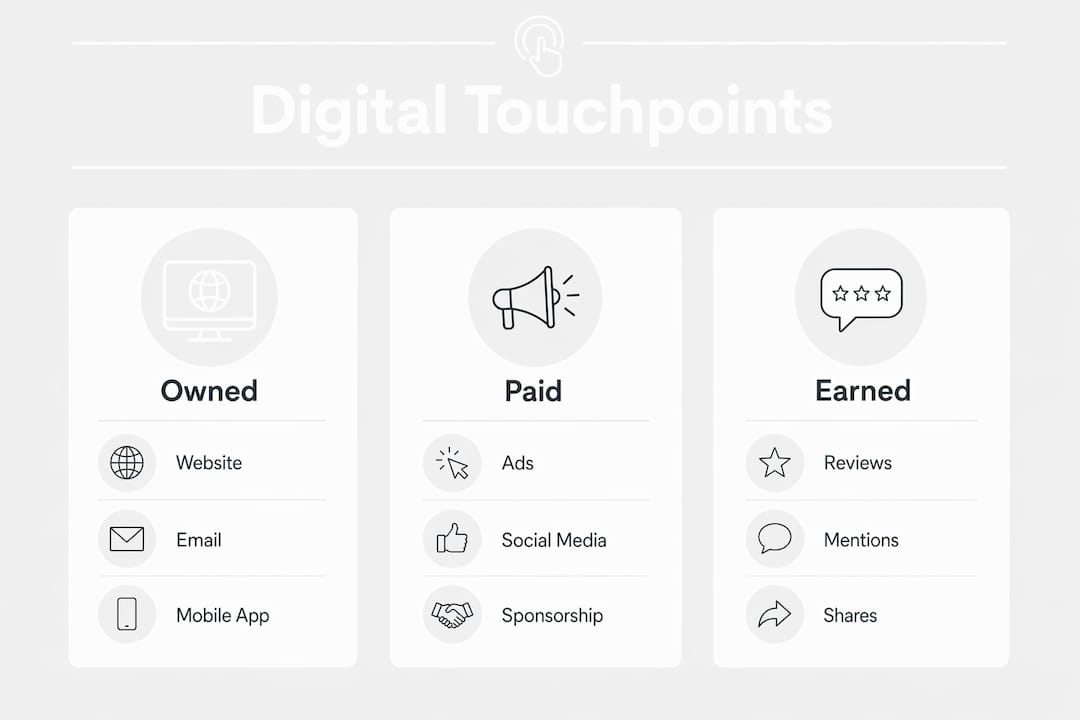
Owned, paid, and earned touchpoints serve distinct roles in the customer journey and marketing funnel. Understanding the difference helps you allocate time and budget more accurately.
Owned touchpoints are channels you control directly:
- Your company website and landing pages
- Email newsletters sent via platforms like Mailchimp or Klaviyo
- Your mobile app, if you have one
- Blog content and SEO-optimised articles
- Live chat or chatbot tools embedded on your site
Paid touchpoints are interactions driven by advertising spend:
- Google Ads search and display campaigns
- Paid social posts on Facebook, Instagram, or LinkedIn
- Sponsored content and influencer partnerships
- Retargeting ads that follow visitors after they leave your site
Earned touchpoints are interactions you did not pay for directly:
- Social shares, mentions, and user-generated content
- Online reviews on Google, Trustpilot, or Tripadvisor
- Press coverage and backlinks from third-party sites
- Word-of-mouth referrals that begin online
Beyond these three categories, passive touchpoints also influence perception. A brand mention in a forum thread, a screenshot shared on Reddit, or a comparison article written by a blogger all shape how potential customers view you before they ever visit your site. You cannot control passive touchpoints, but you can monitor them using tools like Google Alerts or Mention. Understanding digital outreach channels helps you see where earned and passive touchpoints are most likely to appear.
How do digital touchpoints shape the customer journey?
Customer journey touchpoints appear at every stage of the buying process, from the moment someone first hears about your business to the point where they become a loyal advocate. The five stages are awareness, consideration, purchase, post-purchase, and loyalty. Each stage has its own set of interactions, and the quality of those interactions determines whether a customer progresses or drops off.
Digital customer experience differs from traditional CX by being always-on, data-driven, and omnichannel with hyper-personalisation. That contrast matters for small businesses because it means customers now expect a consistent experience whether they find you through a Google search at midnight or a Facebook ad on a Saturday morning. The table below shows how traditional and digital customer experiences compare across key dimensions.
| Dimension | Traditional CX | Digital CX |
|---|---|---|
| Availability | Business hours only | 24/7 across all channels |
| Personalisation | Limited, based on past purchases | Real-time, data-driven |
| Speed of response | Hours or days | Seconds via chatbots or automation |
| Feedback collection | Surveys and phone calls | In-app prompts, email, social listening |
| Channel consistency | Often siloed | Omnichannel, integrated data |
Post-purchase touchpoints have a disproportionate impact compared to acquisition touchpoints. An order confirmation email, a follow-up message checking satisfaction, or a well-handled complaint all carry more weight than most businesses realise. Getting someone to buy is only half the job. What happens after the sale determines whether they return and whether they tell others.
Why is optimising digital touchpoints essential for small businesses?
Fragmented touchpoints are one of the most common and costly mistakes small businesses make. When your Instagram page promises one thing and your website delivers another, or when a customer gets a warm reply on social media but a cold automated email from your CRM, the inconsistency damages trust. Seamless data flow between channels like chatbots and human agents enables personalisation at scale and better digital CX. Without integration, you are essentially running separate businesses under one brand name.
The practical benefits of optimising your digital engagement touchpoints are measurable. Higher email open rates, longer website sessions, lower cart abandonment, and improved review scores are all downstream results of touchpoint quality. These metrics connect directly to revenue, which is why tracking digital marketing metrics should sit alongside any touchpoint improvement programme.
AI and real-time data enable businesses to anticipate needs and provide predictive personalisation across digital touchpoints. This shifts customer interactions from reactive to proactive. A small business using a CRM like HubSpot or Zoho CRM can trigger a personalised follow-up email based on browsing behaviour, without any manual effort. That kind of automation was once reserved for enterprise brands. It is now accessible to any SMB willing to set it up.
Pro Tip: Do not try to optimise every touchpoint at once. Identify the two or three interactions where customers most commonly drop off or express frustration, and fix those first. A focused effort on your highest-traffic landing page or your post-purchase email sequence will deliver faster, more measurable results than spreading effort thinly across every channel.
Customer loyalty is strengthened by rapid, generous complaint resolution and consistent communication during the post-purchase gap. Poor handling creates negative sentiment that extends far beyond the original product experience. Treat every complaint as a touchpoint that is visible to future customers, because on platforms like Google and Trustpilot, it genuinely is.
How can businesses map and measure their digital touchpoints?
Customer journey mapping is the technique used to identify, visualise, and analyse every touchpoint a customer encounters. Best practices include spanning from initial awareness to post-purchase with attention to touchpoint sequencing and sentiment. The process does not require expensive software. A spreadsheet and honest input from your team and customers will get you started.
Follow these five steps to map your digital touchpoints effectively:
- Define your customer personas. Identify who your typical customers are, what they want, and how they behave online. A local restaurant owner and a B2B software buyer have entirely different touchpoint journeys.
- Map the full journey. List every stage from awareness to loyalty and write down every digital interaction that could occur at each stage. Include touchpoints you did not create intentionally, such as review sites and social mentions.
- Gather real data. Use Google Analytics 4, Hotjar, or your CRM to see where customers actually spend time, where they leave, and what they click. Assumptions are not enough.
- Collect direct feedback. Point-in-time surveys are more effective than aggregate scores. Ask customers about specific interactions immediately after they occur, using tools like Typeform or Google Forms.
- Identify and prioritise pain points. Look for stages where customers drop off, complain, or express confusion. These are your highest-priority optimisation targets.
On the measurement side, effective touchpoint attribution requires tracking full interaction sequences instead of last-click only to avoid misallocating budget. If you only credit the final touchpoint before a sale, you will undervalue the blog post that first brought a customer to your site or the retargeting ad that brought them back. Use multi-touch attribution models where possible, and do not ignore offline or view-through events that create blind spots in digital-only analyses.
What emerging digital touchpoints should SMBs watch in 2026?
The range of digital touchpoints available to small businesses has expanded considerably. AI-powered chatbots, personalised onboarding sequences, and voice assistants like Amazon Alexa and Google Assistant now represent genuine customer interaction points that influence brand perception. Social media platforms have become critical customer service channels, where brand responses form public touchpoints visible to all customers. A reply to a complaint on TikTok or a response to a question in Instagram comments is not a private conversation. It is a public signal about how your business treats people.
Push notifications, interactive content like quizzes and calculators, and self-service knowledge bases are also growing as touchpoints. They give customers control over how they engage, which tends to increase satisfaction. Staying current with emerging digital marketing trends helps you identify which new touchpoints are worth adopting for your specific audience.
Pro Tip: Before adopting any new touchpoint technology, ask whether your customers actually use it. A sophisticated AI chatbot is wasted if your audience prefers a simple contact form. Match your touchpoint investment to your customers’ actual behaviour, not to what looks impressive.
Digital transformation enables a shift from transactional interactions to predictive, anticipatory customer experiences, differentiating brands in competitive markets. For SMBs, this means the gap between a well-managed digital presence and a neglected one is growing wider every year.
Key takeaways
Mapping, integrating, and consistently optimising your digital touchpoints is the most direct route to improved customer retention and sustainable business growth.
| Point | Details |
|---|---|
| Define touchpoints broadly | Every online interaction, including reviews and social replies, shapes brand perception. |
| Know your three types | Owned, paid, and earned touchpoints each serve a distinct role in the customer journey. |
| Post-purchase matters most | Order confirmations, complaint handling, and follow-ups drive loyalty more than acquisition touchpoints. |
| Map before you optimise | Use customer journey mapping and real analytics data before deciding what to fix. |
| Focus on integration | Consistent data flow between channels prevents the fragmented experiences that erode trust. |
Why I think most SMBs are looking at touchpoints the wrong way
Most small business owners I speak with think of digital touchpoints as marketing channels. They ask which platform to post on or which ad format to use. That framing misses the point entirely. A touchpoint is not a channel. It is a moment of perception. The same Instagram platform can be a positive touchpoint or a damaging one depending on how you respond to a comment.
The businesses I see winning are not necessarily on more channels. They are more deliberate about the quality of each interaction. A plumber in Blackpool with a fast-loading website, a genuine Google review response strategy, and a simple follow-up text after each job will outperform a competitor with a larger ad budget and a neglected inbox.
The other misconception worth challenging is that touchpoint optimisation is a one-time project. It is not. Customer expectations shift, platforms change their algorithms, and your own business evolves. The businesses that treat touchpoint quality as an ongoing discipline rather than a campaign will compound their advantage over time. Start small, measure honestly, and keep improving. That approach works regardless of your budget or sector.
— tibor
How Fyldedigital helps SMBs build better digital experiences

If you have read this far, you already understand that your website is one of the most important digital touchpoints your business owns. It is the one channel you control completely, and it is often the first place a potential customer forms an opinion about you. Fyldedigital works with small and medium-sized businesses across the Fylde Coast and beyond to build websites that do more than look good. Our web design services in Blackpool are built around conversion-focused layouts, mobile-first design, and SEO foundations that support every stage of the customer journey. If you want a free website review, get in touch and we will show you exactly where your current touchpoints are letting you down.
FAQ
What are digital touchpoints in simple terms?
A digital touchpoint is any online interaction between a customer and your brand, including your website, social media posts, emails, ads, and chatbots. Each interaction influences how the customer perceives your business.
What are the three types of digital touchpoints?
The three types are owned (your website and email), paid (Google Ads and social advertising), and earned (reviews, shares, and referrals). Each type plays a different role across the customer journey.
How do I start mapping my digital touchpoints?
Begin by defining your customer personas, then list every digital interaction they could have with your brand from first discovery through to post-purchase. Use Google Analytics 4 and direct customer feedback to validate your assumptions with real data.
Why are post-purchase touchpoints so important?
Post-purchase touchpoints such as order confirmations, onboarding emails, and complaint responses have a disproportionate impact on customer retention and loyalty compared to the touchpoints that drive initial acquisition.
How many digital touchpoints should a small business focus on?
Start with the two or three touchpoints where customers most commonly drop off or express dissatisfaction. Fixing high-impact weak points delivers faster results than attempting to improve every channel simultaneously.