Evergreen content is high-quality, search-optimised material that stays relevant and useful for months or years after publication, without needing a complete rewrite. Unlike a news article or a trend-led post, it answers questions people ask repeatedly, regardless of the season or news cycle.
Three reasons it belongs in your content plan:
- Search performance: Pages built around stable “what is” and “how-to” queries tend to accumulate rankings and organic traffic over time, rather than spiking and fading.
- Longevity: A well-crafted evergreen resource can generate leads and enquiries long after the initial effort of creating it.
- Funnel utility: Evergreen pieces work at every stage of the buyer journey, from early awareness through to conversion, making them versatile assets for any content strategy.
Your next step: choose one canonical topic your audience asks about repeatedly, write a thorough “how-to” or “what is” guide around it, and publish it with proper on-page SEO in place.
Table of Contents
- What is evergreen content and where does the idea come from?
- Evergreen, seasonal, or trending: which should you choose?
- What formats work best for evergreen content?
- Why evergreen content delivers better long-term results
- How to create evergreen content that ranks and endures
- How to promote and repurpose evergreen content
- How often should you update evergreen content?
- How to measure evergreen content performance
- How Fyldedigital builds and sustains evergreen content
- Key takeaways
- The case for treating evergreen content as infrastructure
- Fyldedigital can help you build content that keeps working
- Useful sources and further reading
What is evergreen content and where does the idea come from?
The term has its roots in broadcasting and journalism), where “evergreen” described stories that could be held in reserve and published at any time because they were not tied to breaking news. Digital marketers borrowed the concept directly: content created once, reused and repurposed many times to maintain visibility and fill gaps in a publishing calendar.

The expanded definition for digital marketing is this: evergreen content is high-quality, search-optimised material that remains relevant, useful, and accurate for a long period, often years, without frequent major updates. It serves as a pillar for SEO strategy and helps build topical authority while lowering long-term customer acquisition costs.
A piece of content qualifies as genuinely evergreen when it meets four criteria:
- Timeless topic: the subject matter does not depend on current events, seasonal trends, or a specific year.
- Repeatable search intent: it targets “what is” or “how-to” queries that people search consistently over time.
- Low date dependency: it avoids references to temporary tools, fleeting statistics, or pop-culture moments that will date it quickly.
- Canonical potential: it aims to become the definitive resource for its query, the page other sites link to and Google returns first.
A practical example: a post titled “How to start a blog” has been searched consistently for years and will continue to be. A post titled “The best blogging trends of 2024” had a shelf life of roughly twelve months. The distinction between an evergreen topic and evergreen content matters during planning: choose a stable topic first, then design content that avoids time-bound data and uses modular sections for easier future updates.
Evergreen, seasonal, or trending: which should you choose?
All three content types have a place in a well-balanced plan. The question is knowing which serves which goal.

| Content type | Typical lifespan | Update frequency | Search intent | Best used for |
|---|---|---|---|---|
| Evergreen | Years | Annual light refresh | Informational, stable (“what is”, “how to”) | Organic traffic, backlinks, funnel top-of-funnel |
| Seasonal | Weeks to months | Annually before the season | Navigational, transactional (“Black Friday deals”, “Christmas gift ideas”) | Promotional campaigns, short-term conversions |
| Trending | Days to weeks | Rarely (often retired) | Informational, news-driven (“AI news today”) | Brand awareness, social shares, PR |
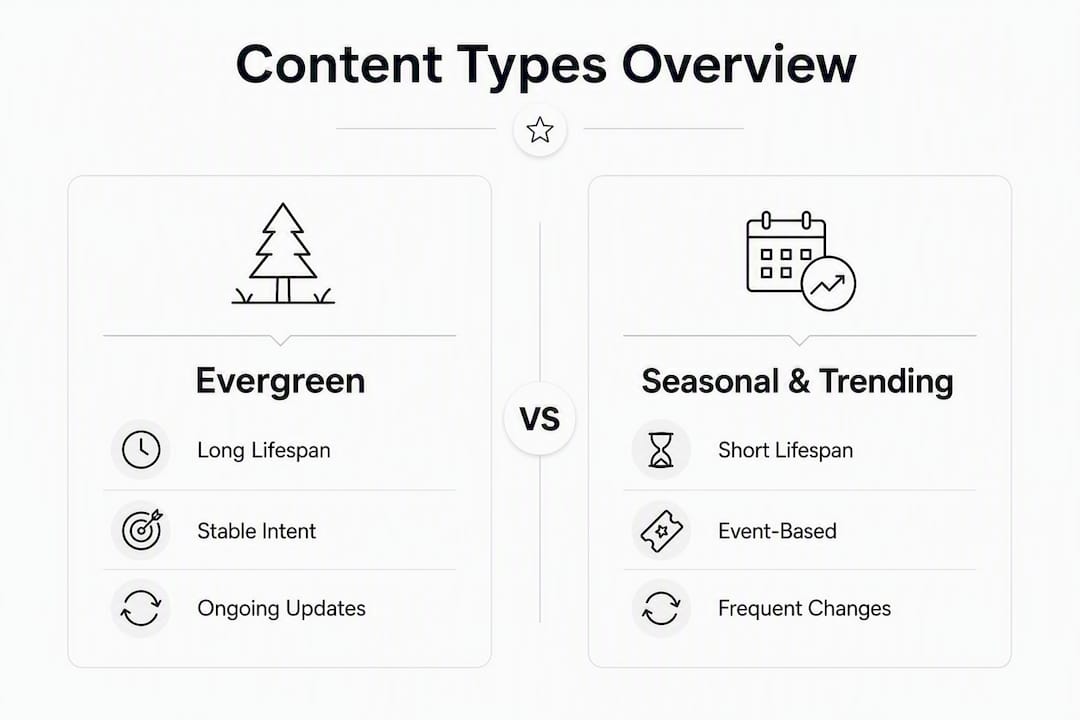
Seasonal content earns its place around predictable calendar events: a UK retailer writing about gift guides each November, or an accountancy firm publishing a self-assessment deadline reminder each January. Trending content captures short-term search spikes and social attention, but it rarely compounds in value the way evergreen pieces do.
The practical approach is to build your content calendar around an evergreen core, then layer seasonal and trending pieces on top. A good rule of thumb: if most of your organic traffic relies on content that expires, your visibility is fragile. Pairing your digital marketing strategy with a strong evergreen foundation gives you a base of consistent traffic that seasonal spikes can build on, rather than replace.
What formats work best for evergreen content?
Format matters less than the content’s ability to remain the canonical resource for a recurring query. That said, certain formats lend themselves to evergreen treatment because they address core questions that do not shift with news cycles.
The formats that consistently perform:
- How-to guides: step-by-step instructions for processes that do not change frequently (“How to set up Google Search Console”, “How to write a meta description”).
- Ultimate guides and long-form explainers: comprehensive resources that cover a topic end-to-end, designed to become the go-to reference.
- FAQs: structured answers to the questions your audience asks most often; these align naturally with featured-snippet opportunities.
- Checklists: practical, scannable resources people return to repeatedly (“Beginner’s SEO checklist”, “Website launch checklist”).
- Glossaries: definitions of industry terms that new practitioners always need (“SEO terminology explained”).
- Foundational case studies: anonymised performance stories that illustrate principles rather than time-specific campaigns.
- Evergreen video: tutorial-style content on YouTube that answers stable “how-to” questions tends to accumulate views over months and years, not just in the first week after upload.
Two platform-specific notes worth keeping in mind:
YouTube: how-to tutorials and process walkthroughs are the platform’s strongest evergreen format. A video titled “How to do keyword research for beginners” will attract search traffic on YouTube itself, not just Google, and can remain relevant for years if the core process it covers stays stable.
Instagram: evergreen value on Instagram comes from saved posts and Story Highlights rather than feed reach. Educational carousel posts (“5 things every small business website needs”) and pinned Highlights covering your core services or FAQs act as persistent resources that new followers discover long after the original post date.
For B2B marketers, two titles that illustrate genuinely evergreen topics: “Beginner’s SEO checklist for small businesses” and “How to set up Google Search Console.” Both address stable processes, target consistent search intent, and can be updated in sections without a full rewrite.
Why evergreen content delivers better long-term results
The core business case is straightforward. A single well-crafted evergreen resource can attract organic traffic month after month and earn backlinks over time, whereas a trend-led post typically delivers a traffic spike in the first week and then fades. The compounding effect is the key difference: each month an evergreen page ranks, it accumulates more signals, more links, and more authority.
Four specific advantages for UK marketers and content teams:
Steady organic traffic. Evergreen pages target queries with consistent monthly search volume. Rather than chasing spikes, you build a reliable baseline of organic sessions that your business can count on.
Link attraction. Other publishers and bloggers naturally link to definitive resources when they need to cite a source. A thorough “what is” or “how-to” guide earns links passively in a way that a news post rarely does. Those links, in turn, strengthen your domain authority and help other pages on your site rank.
Long-term conversion funnel support. An evergreen piece that answers a foundational question (“What is SEO?”) introduces your brand to prospects at the research stage. With a well-placed call to action and internal links to relevant service pages, it can move readers further down the funnel without any additional spend.
Lower ongoing production cost. Publishing a steady stream of topical content to maintain traffic is expensive in time and resource. One strong evergreen asset, refreshed annually, can outperform dozens of short-lived posts over a two-year horizon.
One misconception to address directly: evergreen does not mean “publish and forget.” The set-and-forget assumption is one of the most common reasons evergreen pages lose rankings. True longevity comes from high-quality creation combined with diligent, scheduled maintenance.
How to create evergreen content that ranks and endures
This is a repeatable workflow, not a one-off task. Follow the steps in order and you will produce content built to last.
-
Validate the topic. Confirm the subject has stable, year-round search interest. Use Google Trends to check that the query does not spike seasonally and then collapse. If interest is consistent, the topic is a candidate.
-
Select the right keyword. Focus on “what is” and “how-to” intent. These queries signal that the searcher wants a thorough explanation, not a news update. Avoid tying the piece to a specific year in the title or body.
-
Review what already ranks. Identify the current canonical pages for your target query. Understand what they cover, where they fall short, and what you can do better. Your goal is to produce a resource that is more comprehensive, more clearly structured, or more practically useful than what already exists.
-
Draft for depth and clarity. Write to answer the query completely. Use modular sections with clear H2 and H3 headings so that individual sections can be updated later without rewriting the whole piece. Avoid time-bound statistics where possible; when you must include a figure, note the source date so a future editor knows when to check it.
-
Optimise on-page. Place the primary keyword in the title tag, the H1, the first paragraph, and at least one H2. Add schema markup where relevant (FAQ schema for FAQ sections, HowTo schema for step-by-step guides). Include internal links to related service or resource pages.
-
Run a pre-publication checklist:
- Title tag within 50–60 characters, primary keyword included
- Meta description written with a clear benefit and a call to action
- H1 matches or closely mirrors the title tag
- At least two internal links to relevant pages on your site
- At least one external link to an authoritative source
- Images compressed and alt text written
- Schema markup applied where appropriate
- Editorial review completed by a second pair of eyes
-
Build a promotion plan before you publish. New evergreen pages face strong competition from established, high-authority resources. Content quality alone is rarely sufficient. Plan outreach to relevant sites for links, schedule social promotion, and identify email newsletter slots before the piece goes live.
Timeline for small businesses: expect three to six months before a new evergreen page gains meaningful organic traction. The investment is front-loaded; the returns are long-term.
Pro Tip: Write each major section of your evergreen piece as a self-contained module. Include a brief internal note (visible only to editors) flagging which statistics or tool references are most likely to need updating. This cuts your annual refresh time significantly and means a junior team member can handle routine maintenance without touching the core argument.
How to promote and repurpose evergreen content
Publishing is the beginning, not the end. An evergreen piece needs active promotion to build the authority that makes it self-sustaining.
Organic search is the primary channel, but it takes time. Support the page with internal links from other relevant posts on your site, and reach out to relevant UK publications, directories, and bloggers who might link to a thorough resource in your niche.
Social amplification works differently for evergreen content than for news. Rather than a single post at publication, schedule the piece to resurface periodically. A social media content calendar that includes evergreen resurfacing slots, perhaps quarterly, keeps the content in front of new followers without overexposing it to your existing audience.
Email newsletters are underused for evergreen promotion. Feature the piece in a dedicated send at launch, then resurface it in a “from the archive” slot every six to twelve months. Subscribers who joined after the original send will see it as new, and it reinforces your expertise with long-term readers.
Syndication and outreach can accelerate link acquisition. Pitch the resource to industry newsletters, trade publications, and relevant roundup posts. A well-structured how-to guide or glossary is the kind of resource editors are happy to reference.
Repurposing extends the life of the original investment. A long-form blog post can become a LinkedIn article thread, a short YouTube tutorial, a downloadable checklist, or a series of educational Instagram carousel posts. Each repurposed format reaches a different segment of your audience and creates additional entry points back to the original piece.
The practical automation tip: use a scheduling tool to queue evergreen social posts on a rotation, but cap each piece to no more than one social appearance per quarter per platform. Overexposure to the same content frustrates followers and signals low content volume.
How often should you update evergreen content?
The honest answer is: less often than you fear, but more often than most teams manage. A realistic review schedule for most evergreen assets is a light quarterly signals check and a fuller annual refresh.
Quarterly signals check (15 minutes per piece):
- Has organic traffic dropped noticeably in Google Search Console?
- Have rankings for the primary keyword shifted significantly?
- Are there any broken links or tools referenced that no longer exist?
If the answer to all three is no, the piece is healthy. Move on.
Annual refresh (triggered by the calendar, not just by decline):
Update statistics to the most recent available figures, add new examples that reflect current practice, improve internal linking to any new pages published since the last review, and check that the structure still matches how people are searching for the topic. Refreshes should include updated statistics, new examples, and improved readability to recover or maintain SERP positions.
Triggers that should prompt an immediate, unscheduled update:
- A ranking drop of five or more positions sustained over four weeks
- A traffic decline of 20% or more month-on-month with no obvious seasonal explanation
- A competitor publishing a clearly superior canonical resource on the same topic
- A policy, regulatory, or industry standards change that makes part of your content inaccurate
- Broken links to tools, sources, or internal pages
The misconception that evergreen content needs no maintenance is what causes previously strong pages to quietly lose rankings over eighteen to twenty-four months. A brief annual review is far less effort than rebuilding a page that has slipped off page one.
How to measure evergreen content performance
Tracking the right metrics tells you whether a piece is compounding in value or quietly declining. For UK marketers, these are the KPIs that matter most:
- Organic sessions: the primary indicator of whether the page is attracting search traffic. Track month-on-month and year-on-year in GA4.
- Ranking positions: monitor the primary keyword and its close variants in Google Search Console. A page ranking in positions 4–10 has room to grow with a targeted refresh; a page that has slipped to page two needs attention.
- Backlink growth: use Ahrefs or Semrush to track referring domains over time. A healthy evergreen page should accumulate new links gradually, not lose them.
- Conversions attributable to the asset: set up a goal or conversion event in GA4 tied to the page, whether that is a form submission, a phone call, or a click to a service page.
- Engagement metrics: time on page and scroll depth (available in GA4) indicate whether readers are actually consuming the content or bouncing. A high bounce rate on an evergreen piece often signals a mismatch between the title and the content, or a page that loads too slowly.
Quick checks using Google Search Console and GA4:
In Search Console, filter by page URL and review impressions, clicks, and average position over a 90-day window. A declining click-through rate at a stable impression count usually means the title or meta description needs refreshing. In GA4, use the Pages and Screens report filtered to the specific URL, and check average engagement time alongside the conversion event count.
Tool options for UK agencies and SMEs:
Google Search Console and GA4 are free and cover the fundamentals. Ahrefs and Semrush provide deeper keyword tracking, backlink analysis, and competitor benchmarking; both are widely used by UK agencies. For smaller businesses with tighter budgets, Google Search Console alone is sufficient to monitor the core health of an evergreen page.
Realistic benchmarks: a brand-new evergreen page on a modest-authority domain typically takes three to six months to reach stable rankings. An established page on a domain with strong authority can rank within weeks. Set expectations accordingly, and do not judge a new piece’s performance in the first sixty days.
How Fyldedigital builds and sustains evergreen content
The workflow Fyldedigital uses for evergreen content follows a four-stage cycle: discovery, creation, promotion, and maintenance.
- Discovery: identify the queries clients’ audiences ask repeatedly, validate consistent search volume, and confirm the topic is not tied to a short-lived trend.
- Creation: produce a comprehensive, modular resource optimised for the primary query, with internal links, schema markup, and a clear editorial review before publication.
- Promotion: outreach for initial links, social scheduling across the first quarter, and a feature in the client’s email newsletter at launch.
- Maintenance: quarterly signals check in Google Search Console, annual refresh of statistics and examples, and an immediate review if rankings drop or a competitor publishes a stronger resource.
The results from this approach, drawn from Fyldedigital’s SEO growth case study, reflect what consistent evergreen investment produces over time:
One practical takeaway you can act on this quarter: identify the single most-asked question in your niche that you do not yet have a canonical page for. Write a thorough, well-structured answer to it, optimise it properly, and build a promotion plan before you publish. That one resource, maintained annually, is likely to outperform a month’s worth of topical posts in organic value within a year.
Author: tibor | Fyldedigital
Key takeaways
Evergreen content compounds in value over time precisely because it targets stable search intent, earns backlinks passively, and supports the buyer journey at every stage without requiring constant reinvestment.
| Point | Details |
|---|---|
| Choose stable topics | Target “what is” and “how-to” queries with consistent year-round search volume, not trend-led or date-specific subjects. |
| Build for canonical status | Write the most comprehensive, clearly structured resource for your query; format is secondary to depth and authority. |
| Promote before and after launch | New evergreen pages need outreach and link-building to compete; content quality alone is rarely sufficient against established pages. |
| Set a review cadence | Run a quarterly signals check and an annual refresh; update statistics, examples, and internal links to maintain rankings. |
| Measure the right KPIs | Track organic sessions, ranking positions, backlink growth, and conversions in GA4 and Google Search Console. |
| Fyldedigital’s approach | Fyldedigital applies a four-stage discovery, creation, promotion, and maintenance cycle to build evergreen assets that compound in organic value over time. |
The case for treating evergreen content as infrastructure
Most content teams treat evergreen pieces as a publishing format. The more useful frame is infrastructure: a small number of well-maintained canonical resources that underpin everything else you publish.
The conventional advice is to produce more content, more often. The reality, in my experience working with UK businesses, is that a handful of genuinely authoritative evergreen pages, properly promoted and maintained, deliver more consistent organic value than a high-volume publishing schedule built on topical posts. The compounding effect is not theoretical; it shows up in Search Console data month after month.
The habit worth adopting is a monthly content triage. Set aside thirty minutes to review your top five organic pages in Google Search Console. Check whether rankings are holding, whether click-through rates are declining, and whether any competitor has published something stronger. That routine catches problems early, before a quiet ranking slip becomes a significant traffic loss. It also keeps your team focused on maintaining what works rather than constantly chasing new topics.
Evergreen content rarely fails because of poor writing. It fails because teams publish it and move on, assuming the work is done. The maintenance mindset is what separates content that compounds from content that quietly fades.
Fyldedigital can help you build content that keeps working
If you want organic traffic that does not depend on publishing a new post every week, a structured evergreen content strategy is the most efficient route. Fyldedigital works with small and medium-sized businesses across the UK to develop content strategies built around canonical evergreen resources: from topic discovery and keyword research through to creation, on-page SEO, promotion, and scheduled maintenance.

The practical starting point for most businesses is a content audit: understanding which pages already have evergreen potential, which are underperforming, and where the clearest opportunities lie. From there, Fyldedigital’s team can build and maintain the assets that drive consistent enquiries and leads over the long term.
If you are ready to put a proper evergreen strategy in place, start with Fyldedigital’s SEO best practices guide or get in touch for a free SEO review of your current content.
Useful sources and further reading
- Parse.ly: Evergreen Content Definition and Examples — a concise, authoritative definition of evergreen content and its core characteristics; a good starting point for anyone new to the concept.
- Search Engine Land: What Is Evergreen Content? — a thorough practitioner guide covering SEO strategy, topical authority, and the business case for evergreen investment.
- Ahrefs: Evergreen Content Glossary — covers keyword selection, maintenance advice, and the competitive reality of ranking new evergreen pages against established ones.
- Semrush: Evergreen Content Misconceptions and Maintenance — addresses the “set and forget” misconception directly and provides practical guidance on refresh cycles.
- Search Engine Journal: Evergreen Topics vs Evergreen Content — explains the important distinction between choosing a stable topic and designing content that avoids time-bound data; useful for the planning stage.
- Evergreen (media) — Wikipedia) — the origin of the term in broadcasting and journalism, useful context for understanding why the concept translates so directly to digital content strategy.