Blog content is the primary mechanism by which most websites build organic visibility, attract qualified traffic, and establish authority with search engines. A SEOZoom study of over 27,000 websites found that sites with active blogs see up to 60.4% higher organic traffic than non-blogging counterparts. That figure alone makes the case for blogging as a core SEO investment, not an optional extra. The role of blog content in SEO extends far beyond simply publishing articles. It shapes how search engines understand your site, how users find you, and how your brand earns trust over time. Fyldedigital works with businesses across the Fylde Coast and beyond to turn blog content into a measurable growth asset.
How does blog content improve keyword rankings and search visibility?
Blog content expands the range of keywords your site can rank for. A static website with five service pages can realistically target five to ten keyword phrases. A site with an active blog can target hundreds, covering every stage of the buyer journey from awareness to purchase.
The most valuable keyword territory for most businesses is long-tail search. These are specific, multi-word phrases like “best accountant for sole traders in Lancashire” rather than simply “accountant.” Long-tail keywords carry lower competition and higher purchase intent. Blog posts are the natural home for this type of content because they allow you to answer specific questions in depth.

Search intent is the other critical factor. Google classifies searches as informational, commercial, or transactional. A well-planned blog covers all three. An informational post answers a question. A commercial post compares options. A transactional post supports a buying decision. Mapping your blog topics to these intent categories means your content meets readers at the right moment.
The SEOZoom data also shows that blogging sites are 47.2% more effective at pushing keywords into the top 10 search results for smaller sites. Ranking on page one is not luck. It is the result of consistent, well-structured content that matches what people are actually searching for.
Internal linking is another direct benefit. Each new blog post creates an opportunity to link to your service pages, product pages, and related articles. Internal linking supports search engines’ understanding of content hierarchy and distributes link equity across your site. This improves crawlability and helps Google index your pages more efficiently.
- Target long-tail keywords in every post to capture specific, high-intent searches.
- Map topics to search intent so each post serves a clear purpose in the buyer journey.
- Build topic clusters by grouping related posts around a central pillar page.
- Use internal links in every post to connect your content and strengthen site structure.
- Update posts regularly to maintain rankings as search algorithms evolve.
Pro Tip: Use Google Search Console to identify which queries already bring visitors to your site, then write blog posts that go deeper on those exact topics. You are building on existing momentum rather than starting from scratch.
What makes blog content effective for SEO in 2026 and beyond?
The definition of effective blog content has shifted significantly. The role of blog content has evolved from keyword stuffing toward demonstrating comprehensive topical authority and brand expertise. Search engines in 2026 reward sites that cover a subject thoroughly, not sites that repeat a keyword phrase twenty times per page.
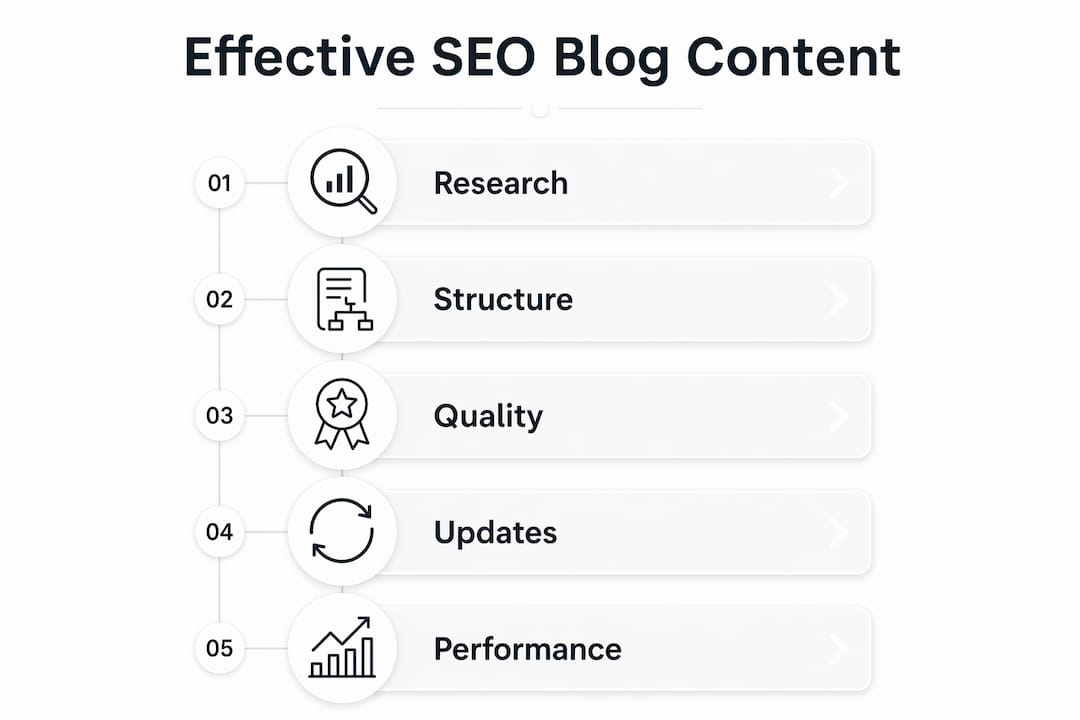
Topical authority is built through clusters of semantically related content. A single post about “email marketing” carries limited weight. A cluster of twelve posts covering email list building, subject line optimisation, segmentation, automation, and deliverability signals to Google that your site genuinely understands the subject. Topical authority signals brand expertise and is critical in modern helpful-content-focused search algorithms.
Effective blog content in 2026 must also satisfy E-E-A-T: Experience, Expertise, Authoritativeness, and Trustworthiness. These are the four qualities Google’s quality raters use to assess content. Practically, this means:
- Write from genuine experience. Share real examples, case studies, or data from your own work. Generic advice scores poorly on E-E-A-T.
- Demonstrate expertise. Cite credible sources, reference industry standards, and show command of the subject matter.
- Build authoritativeness. Earn backlinks from respected sites and publish consistently under named authors with verifiable credentials.
- Earn trust. Use accurate information, clear sourcing, and transparent business details. Avoid misleading claims.
Structure matters as much as substance. Clear headings and well-structured content increase the chances of being extracted by AI-driven systems for featured snippets and voice search. An answer-first structure, where the key point appears in the first sentence of each section, makes your content easier for both humans and machines to process.
The risk of low-quality AI-generated content is real and growing. Low-value AI-generated blog content can cause de-indexing and harm SEO. The solution is not to avoid AI tools entirely, but to use them to support original thinking rather than replace it. Original data, opinionated analysis, and genuine expertise are what survive quality filters.
Pro Tip: Add a “last updated” date to every blog post and refresh the content every three to six months. High-performing blogs that review and refresh content on this schedule consistently protect their rankings during algorithm updates.
How can businesses develop a strategic blog content plan to maximise SEO benefits?
A strategy-driven blog outperforms ad hoc content in rankings, traffic, and conversions. The difference between a blog that generates leads and one that sits unread is almost always planning. Here is how to build a plan that delivers results.
Keyword research and topic mapping
Start with keyword research. Use tools like Google Keyword Planner or Ahrefs to identify the questions your potential customers are asking. Group these into themes. Each theme becomes a topic cluster with one pillar page and several supporting posts. Understanding how keywords drive rankings is the foundation of any effective blog strategy.
Aligning content with the SEO funnel
Map every blog topic to a funnel stage. Top-of-funnel (TOFU) content attracts new visitors with broad, informational posts. Middle-of-funnel (MOFU) content educates readers who are considering their options. Bottom-of-funnel (BOFU) content supports purchase decisions with comparisons, case studies, and detailed guides. A healthy blog publishes across all three stages.
- TOFU example: “What is content marketing and why does it matter?”
- MOFU example: “How to choose an SEO agency for your small business”
- BOFU example: “What to expect from your first three months of SEO”
Publishing cadence and content updates
Consistency beats volume. Publishing two well-researched posts per month outperforms publishing ten thin posts in a single week. Set a realistic cadence and stick to it. Updating and refreshing blog content regularly protects rankings during algorithm updates and keeps content evergreen.
Tracking performance and iterating
Track the metrics that matter: organic sessions, keyword rankings, time on page, and conversion rate from blog traffic. Key digital marketing metrics tell you which posts are working and which need attention. Review your blog performance monthly and adjust your content plan based on what the data shows.
| Content type | Primary SEO purpose |
|---|---|
| Pillar page | Establishes topical authority for a broad subject |
| Supporting cluster post | Targets specific long-tail keywords within the topic |
| Case study | Builds E-E-A-T and earns backlinks from industry sources |
| FAQ post | Captures featured snippets and voice search queries |
| Comparison post | Targets commercial-intent searches near the buying decision |
What are the measurable impacts of blogging on SEO performance?
The SEOZoom 2026 study provides the clearest data available on blogging’s direct impact on SEO outcomes. The results differ by business size, but the direction is consistent: blogging improves performance across the board.
For small sites, the impact is most dramatic. Sites with active blogs see up to 60.4% higher organic traffic and are 47.2% more effective at pushing keywords into the top 10 search results. For a small business competing against established players, that difference can determine whether you appear on page one or page three.
Medium-sized sites see traffic growth that can reach three times the rate of non-blogging competitors. At this scale, blogging accelerates market share gains and helps businesses enter new keyword territories without relying solely on paid advertising. Blogging content compounds value over months and years, unlike paid ads which stop the moment you stop spending.
Large sites use blogging differently. At scale, the primary benefit shifts from growth to defence. Regular publishing protects existing rankings during algorithm updates and prevents competitors from capturing keyword territory you currently own. The SEO growth case study from Fyldedigital illustrates how consistent content publishing translates into sustained ranking improvements for real businesses.
“A well-planned blog strategy transforms blogging from sporadic content creation into an efficient, predictably scalable SEO growth engine. Businesses that treat their blog as a long-term asset, rather than a short-term tactic, consistently outperform those that publish reactively.”
The long-term economics of blogging are compelling. A post published today can generate traffic for three to five years with minimal additional investment. That compounding return is why the importance of content marketing in SEO continues to grow, even as paid channels become more expensive and competitive.
Key takeaways
Blog content is the single most cost-effective way for businesses to build organic search visibility, establish topical authority, and generate leads that compound in value over time.
| Point | Details |
|---|---|
| Blogging drives measurable traffic growth | Sites with active blogs see up to 60.4% higher organic traffic than non-blogging sites. |
| Topical authority beats keyword repetition | Clusters of related posts signal expertise to search engines far more effectively than isolated articles. |
| E-E-A-T determines content quality | Original experience, credible sourcing, and transparent authorship are the standards Google applies in 2026. |
| Strategy outperforms volume | A consistent, planned publishing cadence delivers better rankings and conversions than sporadic high-volume output. |
| Content compounds over time | Unlike paid advertising, blog posts continue generating traffic and leads for years after publication. |
Why I think most businesses are still getting blogging wrong
After working with businesses on their SEO for years, the pattern I see most often is this: a business publishes ten posts in january, gets excited, then publishes nothing for four months. The blog becomes a graveyard of half-finished ideas rather than a growth engine.
The second mistake is chasing volume over quality. I have seen sites with 300 posts ranking below competitors with 40, simply because the 40 posts were genuinely useful and the 300 were thin rewrites of the same generic advice. Search engines and AI models increasingly prioritise clear, structured, and trustworthy content that answers user questions directly. Volume without quality is not just ineffective. It can actively harm your rankings.
The third mistake is writing for Google rather than for people. The irony is that writing for people is now the best way to rank on Google. Answer the question clearly in the first paragraph. Use plain language. Give a real example. That approach satisfies both human readers and the AI systems that increasingly mediate search results.
My honest recommendation is to publish less and invest more in each post. One genuinely useful, well-structured, 1,500-word article per fortnight will outperform four rushed 400-word posts every time. Treat your blog like your best salesperson. Give it the time and quality it deserves.
— tibor
How Fyldedigital can help you build a blog strategy that ranks
If you have read this far and realised your blog is not working as hard as it should, you are not alone. Most small and medium-sized businesses have untapped SEO potential sitting in their content.

Fyldedigital builds bespoke blog and SEO strategies for businesses that want predictable, long-term organic growth. From keyword research and topic cluster planning to on-page optimisation and content audits, the team handles the detail so you can focus on running your business. Whether you need a full SEO and web design service or a targeted content strategy review, Fyldedigital offers a free SEO review to show you exactly where the opportunities lie. Get in touch to find out what a well-planned blog could do for your search visibility.
FAQ
What is the role of blog content in SEO?
Blog content expands keyword coverage, builds topical authority, and improves internal linking structures. These factors combine to increase a site’s organic visibility and search rankings over time.
How quickly does blogging improve SEO results?
Most sites see measurable ranking improvements within three to six months of consistent publishing. The compounding effect means results accelerate significantly after the first year.
How often should a business publish blog posts?
Two to four well-researched posts per month is the most effective cadence for most small and medium-sized businesses. Consistency matters more than frequency.
Does AI-generated blog content harm SEO?
Low-value AI-generated content risks de-indexing and ranking drops. AI tools work best when used to support original thinking, not replace it. Original data and genuine expertise are what search engines reward.
What is topical authority and why does it matter?
Topical authority is established through clusters of semantically related content that reinforce each other via internal linking. It signals to search engines that your site is a credible, comprehensive source on a given subject.