Social proof is a behavioural shortcut where people look to others’ actions and opinions to guide their own decisions, particularly when they feel uncertain. In marketing terms, it reduces the perceived risk of a purchase or enquiry by showing that other people have already made that choice and found it worthwhile. Think of the Amazon UK product page where a four-star average from 2,400 verified buyers sits directly above the “Add to Basket” button, or the Trustpilot widget on a local service provider’s homepage showing a 4.8 rating. Both are doing the same job: replacing doubt with evidence. As Shopify frames it, social proof is retail psychology in action, and its power comes from the fact that it works on us whether we notice it or not.
Key takeaways
Social proof works because people use others’ choices as a shortcut to reduce uncertainty, and placing that proof at the right moment in the buyer journey is what separates businesses that convert from those that do not.
| Point | Details |
|---|---|
| Core definition | Social proof is a behavioural shortcut where people copy others’ choices to reduce uncertainty. |
| Placement is everything | Reviews placed beside your CTA reduce hesitation at the exact moment a buyer decides. |
| Verified platforms win | Trustpilot, Google Reviews, and TripAdvisor carry more weight than self-published testimonials. |
| Ethics and legality matter | Fake or incentivised reviews breach ASA guidelines and CMA consumer protection rules in the UK. |
| Fyldedigital’s role | Fyldedigital integrates review widgets and trust signals into web design projects for UK SMBs. |
Table of Contents
- What is social proof and how does it work psychologically?
- What types of social proof will you encounter online?
- Where did social proof come from? Cialdini and the research behind it
- Real-world examples that show social proof in action
- How marketers use social proof: tactics that move the needle
- Practical rules for adding social proof to your website or campaign
- How do you measure whether social proof is actually working?
- Limitations, misuse, and the ethics of social proof
- A practical checklist for UK small businesses
- Why social proof matters more than most small businesses realise
- Fyldedigital can help you put social proof to work
- Sources
What is social proof and how does it work psychologically?
The psychological engine behind social proof runs on two distinct mechanisms: informational influence and normative influence.
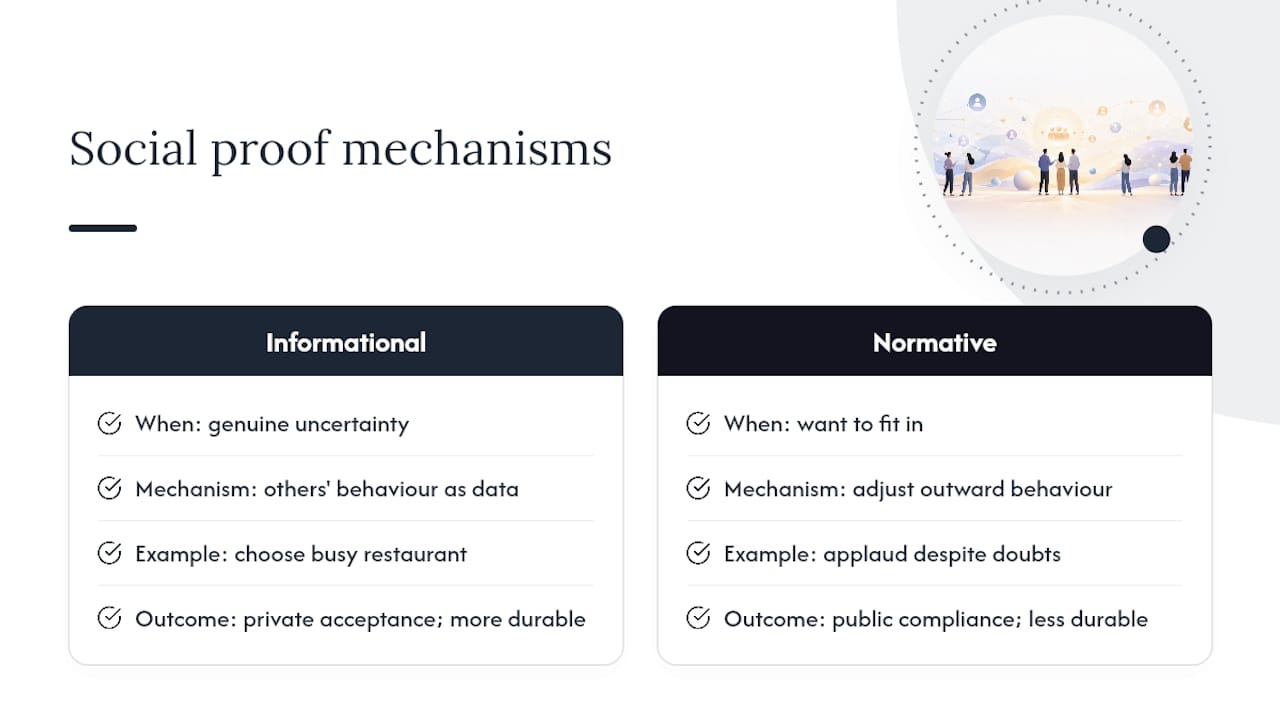
Informational influence kicks in when you genuinely do not know what to do and treat other people’s behaviour as useful data. You are new to a city, you see one restaurant packed and the one next door empty, and you choose the busy one. You have no menu, no reviews, no prior knowledge — just the visible signal that others have already decided. That is informational influence at its most direct.
Normative influence is different. Here, you already have a view, but you adjust your behaviour to fit in with a group, even if privately you are not convinced. You applaud at a concert because everyone else is, even if you thought the performance was mediocre. According to Wikipedia’s account of Cialdini’s work, this distinction maps onto public compliance (going along outwardly) versus private acceptance (genuinely changing your belief). Marketers benefit from both, but private acceptance is the more durable outcome.
The Behavioral Scientist describes social proof as a cognitive shortcut that grows especially powerful under time pressure, distraction, or high ambiguity. When a shopper is comparing five similar products in a hurry, the one with 1,200 reviews and a 4.7 rating wins almost by default. The cognitive load of evaluating each product individually is too high, so the crowd’s verdict becomes a proxy for quality.
What types of social proof will you encounter online?
Social proof appears in several distinct formats, each suited to different contexts and audiences.
- User reviews and star ratings. The most common form online. Platforms such as Google Reviews, Trustpilot, and TripAdvisor aggregate customer feedback into visible scores. A local plumber with 87 Google Reviews at 4.9 stars carries far more weight than one with no reviews at all.
- Expert endorsements and certifications. A professional body’s badge (a CHAS accreditation for a contractor, or a Which? Trusted Trader mark) signals third-party vetting. These work because the endorser has credibility the buyer already trusts.
- Celebrity and influencer endorsements. A recognisable face or a niche content creator recommending a product lends their audience’s trust to the brand. Micro-influencers with engaged followings in a specific sector often outperform broad celebrity deals on conversion.
- Crowd indicators. Labels such as “Best Seller,” “Most Popular,” or “Over 10,000 orders” on Amazon UK product listings signal that many others have chosen this option. The crowd’s choice becomes a shortcut for quality.
- Social counters and follower numbers. A Facebook page with 12,000 followers or a YouTube channel with 50,000 subscribers signals an established, trusted presence. The number itself is the proof.
- Friend and connection-based proof. Seeing that a specific person you know has liked, shared, or purchased something is among the most persuasive signals of all. LinkedIn’s “X connections work here” is a textbook example.
- Case studies and testimonials. Detailed written or video accounts from named clients showing measurable results. These work best for higher-value B2B decisions where a buyer needs more than a star rating before committing.
Where did social proof come from? Cialdini and the research behind it
Robert Cialdini coined the term “social proof” in his 1984 book Influence: The Psychology of Persuasion, placing it among six core principles of persuasion alongside reciprocity, commitment, liking, authority, and scarcity. Wikipedia’s entry on social proof credits Cialdini with popularising the concept and articulating the compliance-versus-acceptance distinction that still underpins most academic and marketing treatments of the subject.
The experimental groundwork predates Cialdini. Solomon Asch’s conformity experiments in the 1950s showed that participants would give obviously wrong answers to simple questions simply because the rest of the group had done so. Muzafer Sherif’s earlier autokinetic effect studies demonstrated that people anchor their judgements to a group norm even when the situation is genuinely ambiguous. Neither experiment was about marketing, but both showed the same underlying truth: humans calibrate their behaviour against others, especially when certainty is low.
Cultural context matters too. Research on collectivist versus individualist cultures consistently finds that normative social proof carries more weight in societies where group harmony is prioritised. In the UK, the effect is strong but tempered by a degree of scepticism about overt endorsements, which is one reason that verified third-party review platforms like Trustpilot and Google Reviews tend to outperform self-published testimonials on a company’s own website.
Real-world examples that show social proof in action
Picture a Saturday morning on a high street. Two coffee shops sit side by side. One has a queue out of the door; the other has empty tables. Most people join the queue without reading a single review. The queue itself is the proof.

Online, the same dynamic plays out on product pages. An item on Amazon UK with 3,400 ratings and a 4.6-star average will consistently outsell a similar product with 12 ratings, even when the lower-reviewed product is objectively comparable. The star rating placed directly beside the “Add to Basket” button reduces hesitation at the exact moment a buyer is deciding. Wharton’s analysis of social proof as a trust signal recommends placing reviews and third-party proof precisely at these decision points, noting that a large share of shoppers check online reviews before choosing a local business.
For a UK service business, consider a local accountancy firm that embeds its Trustpilot widget on its contact page, showing 4.8 stars from 140 reviews. A prospective client who has never heard of the firm arrives via a Google search, sees the rating before they even read the service description, and their initial scepticism drops immediately. That widget is doing the work of a word-of-mouth recommendation at scale.
How marketers use social proof: tactics that move the needle
Knowing what social proof is matters far less than knowing where and how to deploy it. Here are the tactics that consistently produce results, alongside the pitfalls to avoid.
What works:
- Place star ratings and review counts directly beside your primary call to action, not buried in a separate testimonials page.
- Embed a Trustpilot or Google Reviews widget on your homepage and product or service pages so the proof is visible without the visitor needing to navigate away.
- Use user-generated content (UGC) — customer photos, unboxing videos, tagged social posts — on product pages and in email campaigns. UGC reads as more authentic than polished brand photography.
- Add “Most Popular” or “Best Seller” labels to your highest-converting products or service packages. The label itself shifts attention and reduces decision paralysis.
- For B2B businesses, publish case studies with named clients and specific outcomes. A case study showing a 30% increase in leads for a named local business carries more weight than a generic quote.
- Use trust badges (SSL certificates, industry accreditations, payment security logos) near checkout or enquiry forms to reduce abandonment.
What to avoid:
- Do not paste every review you have ever received onto a single page. Overloading a page with proof signals creates clutter and actually reduces trust, as NN/g’s UX research confirms.
- Avoid generic follower counts if your numbers are low. A page with 200 followers signals the opposite of popularity.
- Never fabricate or selectively edit reviews. UK consumers are increasingly alert to inauthentic content, and the reputational damage from exposure far outweighs any short-term conversion gain.
NN/g also finds that endorsements from recognisable or similar people convert better than generic popularity metrics. Showing that “3 businesses in Lancashire purchased this service this month” outperforms a bare total count, because the proof feels personally relevant.
Practical rules for adding social proof to your website or campaign
A structured approach prevents the common mistake of scattering proof points randomly and hoping for the best. Follow this workflow:
1. Collect. Ask for reviews promptly after a purchase or project completion. Email requests sent within 24 hours of delivery consistently achieve higher response rates than those sent a week later. Platforms such as Trustpilot and Google Business Profile both support automated review request emails.
2. Verify and authenticate. Only display reviews from verified purchasers or clients. Unverified testimonials on your own site carry less weight and, under UK Advertising Standards Authority (ASA) guidelines, must not be presented in a way that misleads consumers about their origin.
3. Curate for placement. Not every review belongs on every page. A detailed case study suits a services landing page; a short five-star snippet suits a checkout page. Match the depth of proof to the decision the visitor is making.
4. Present for mobile and desktop. Star ratings and short review snippets render well on mobile; long testimonials do not. Check that any review widget you embed loads quickly and does not push your page’s Core Web Vitals scores down.
5. Test and iterate. Run A/B tests on placement and format before committing. A star rating above the fold may outperform one below it, or vice versa, depending on your audience and page layout. Your website’s conversion performance is the ultimate arbiter.
Pro Tip: Embed review widgets as lightweight scripts rather than full iframes where possible. Heavy third-party embeds can add 300–500ms to page load time, which directly affects both user experience and Google’s Core Web Vitals scores. Test page speed before and after adding any social proof widget.
How do you measure whether social proof is actually working?
The primary KPIs to track are conversion rate on the pages where you have added proof, click-through rate to your CTA, add-to-basket rate for e-commerce, and time-to-purchase. A meaningful drop in time-to-purchase after adding a review widget suggests the proof is reducing hesitation.
Secondary indicators include review volume growth (are more customers leaving reviews after you started asking?), sentiment trends in new reviews, and referral traffic arriving from Trustpilot or Google Reviews directly.
A simple A/B test structure: take a product or service page, create two versions — one with a star rating and review count near the CTA, one without — and split traffic 50/50 for at least two weeks or until you reach statistical significance. The Wharton guidance on trust signals recommends running tests at decision points specifically, because that is where proof has the greatest leverage. Watch for false positives: a short test during an unusual trading period (a sale, a seasonal spike) will skew results. Run tests during representative periods and check that your sample size is large enough to draw conclusions.
Limitations, misuse, and the ethics of social proof
Social proof has a dark side, and UK businesses need to be aware of it. The same mechanism that helps genuine customers make better decisions can be exploited or misused.
Common risks:
- Fake or incentivised reviews. Paying for reviews, offering discounts in exchange for positive feedback, or posting reviews under false identities all breach the ASA’s advertising codes and the Competition and Markets Authority’s consumer protection guidance. The CMA has taken enforcement action against businesses in the UK for exactly this practice.
- Misleading presentation. Cherry-picking only five-star reviews while suppressing negative ones creates a false impression. Under the Consumer Protection from Unfair Trading Regulations 2008, presenting misleading commercial information is a legal offence.
- Negative social proof. Highlighting how many people have not done something (“Most visitors don’t sign up”) can backfire by normalising inaction. Framing matters: always show the positive behaviour you want to encourage.
- Herd behaviour errors. When everyone follows the crowd, collective mistakes amplify. A product with many reviews is not necessarily a good product; it is simply a popular one. Buyers who rely solely on social proof without any independent evaluation can end up disappointed.
Mitigation: Verify reviews through platform-native tools, respond to negative reviews professionally and promptly, and encourage authentic UGC rather than solicited praise. Transparency builds more durable trust than any manufactured signal. Social-engineer that social proof is also a known vector in social engineering attacks, reinforcing why verification and scepticism are healthy habits for both businesses and consumers.
A practical checklist for UK small businesses
Five actions you can take this week to start using social proof effectively:
- Ask for reviews within 24 hours. Send a short, personalised email to every customer immediately after delivery or project completion. Link directly to your Google Business Profile or Trustpilot page.
- Surface your best reviews near your CTAs. Move your strongest testimonial or star rating to sit directly above or beside your primary “Get a Quote” or “Contact Us” button.
- Add a Trustpilot or Google Reviews widget to your homepage. A live widget showing your current rating is more credible than a static screenshot because visitors can click through to verify it.
- Test one placement change. Pick your highest-traffic landing page, add a review snippet near the CTA, and measure conversion rate over four weeks against the previous period.
- Monitor your review KPIs monthly. Track total review count, average rating, and any referral traffic from review platforms in Google Analytics or Search Console.
At Fyldedigital, we have seen clients achieve meaningful improvements in enquiry rates after making straightforward changes to where and how reviews appear on their sites. The gains tend to come not from collecting more reviews but from placing existing ones where they are most visible at the moment a visitor is deciding. For a practical guide to why reviews belong on your website, the Fyldedigital blog covers the specifics in detail. If you would like a free audit of how your current site handles trust signals, that is a good place to start.
Why social proof matters more than most small businesses realise
There is a tendency among UK SMBs to treat reviews as a nice-to-have rather than a core part of their marketing infrastructure. That is a mistake. Statista’s data on consumer trust in advertising consistently shows that recommendations from other consumers rank among the most trusted forms of advertising, well above branded content or paid ads. Your customers’ words carry more weight than yours, full stop.
The subtler point is about placement, not just presence. A business can have 200 Trustpilot reviews and still see no conversion benefit if those reviews are buried on a page nobody visits. The psychology only activates when the proof appears at the moment of uncertainty, which is usually right beside your CTA, on your homepage above the fold, or on a product or service page before the pricing section.
One practical tip drawn from agency work: ask for reviews within 24 hours of a positive interaction, not at the end of a monthly newsletter. The recency of the experience makes the response more specific, more enthusiastic, and more useful to future customers. For businesses that want help building this into their wider digital presence, Fyldedigital’s social media management services include review strategy as part of the broader approach.
Fyldedigital can help you put social proof to work
Building a website that actually converts means more than good design. It means placing the right trust signals in the right places, integrating review platforms properly, and making sure your social proof loads fast and looks credible on every device.

Fyldedigital works with small and medium-sized businesses across the UK on web design, social media management, and SEO, with review integration and trust signal placement built into every project. If your current site has reviews but they are not driving enquiries, the issue is almost always placement or presentation rather than volume. A free website review from Fyldedigital will show you exactly where your proof points are falling short and what a straightforward fix looks like. Request your free review and see what a conversion-focused site can do for your business.
Sources
The sources below underpin the claims made throughout this article. Each is worth bookmarking if you want to go deeper on any specific aspect of social proof.
- The Importance of Social Proof as a Trust Signal – Wharton
- Social proof – Wikipedia
- Use Social Proof and Retail Psychology to Sell More (2026) – Shopify
- Consumer trust in different types of advertising – Statista