Most business owners know that website reviews exist. Far fewer understand what they actually do. If you think of reviews as a nice decorative touch — a row of stars tucked away on a page — you are leaving a significant amount of trust, traffic, and revenue on the table. Understanding why use website reviews strategically, rather than passively, is one of the most practical decisions you can make for your business right now. This article breaks down the real benefits, the hard data behind them, and the steps you can take to make reviews work properly for you.
Table of Contents
- Key takeaways
- Why website reviews build trust
- How reviews shape visitor behaviour
- The SEO advantages of website reviews
- Managing reviews effectively
- Pitfalls that undermine review effectiveness
- My take on why reviews are underestimated
- How Fyldedigital can help you make the most of reviews
- FAQ
Key takeaways
| Point | Details |
|---|---|
| Recency matters enormously | 74% of consumers only trust reviews from the last three months, so you need fresh ones constantly. |
| Volume builds confidence | Fewer than 20 reviews make many potential customers hesitant, regardless of how high your star rating is. |
| Responses signal professionalism | Replying to reviews publicly shows attentiveness and builds far more trust than star ratings alone. |
| Reviews support SEO | User-generated content from reviews adds fresh, keyword-rich material that search engines recognise as a trust signal. |
| Management is not optional | A passive approach to reviews leads to stale content and eroded credibility. Active workflows are what drive results. |
Why website reviews build trust
The moment a potential customer lands on your website, they are asking one silent question: “Can I trust this business?” Your branding, your layout, and your copy all contribute to the answer. But reviews carry a particular kind of weight because they come from people who have no reason to sell anything. That independence is what makes them credible.
The psychology here is well-established. People look to the experiences of others when they are unsure what to do. This is especially true for purchases or enquiries where the risk feels significant, whether that is hiring a tradesperson, choosing a solicitor, or selecting a new supplier. Reviews act as third-party proof that substitutes for your own claims, which no potential customer will ever fully believe on their own.
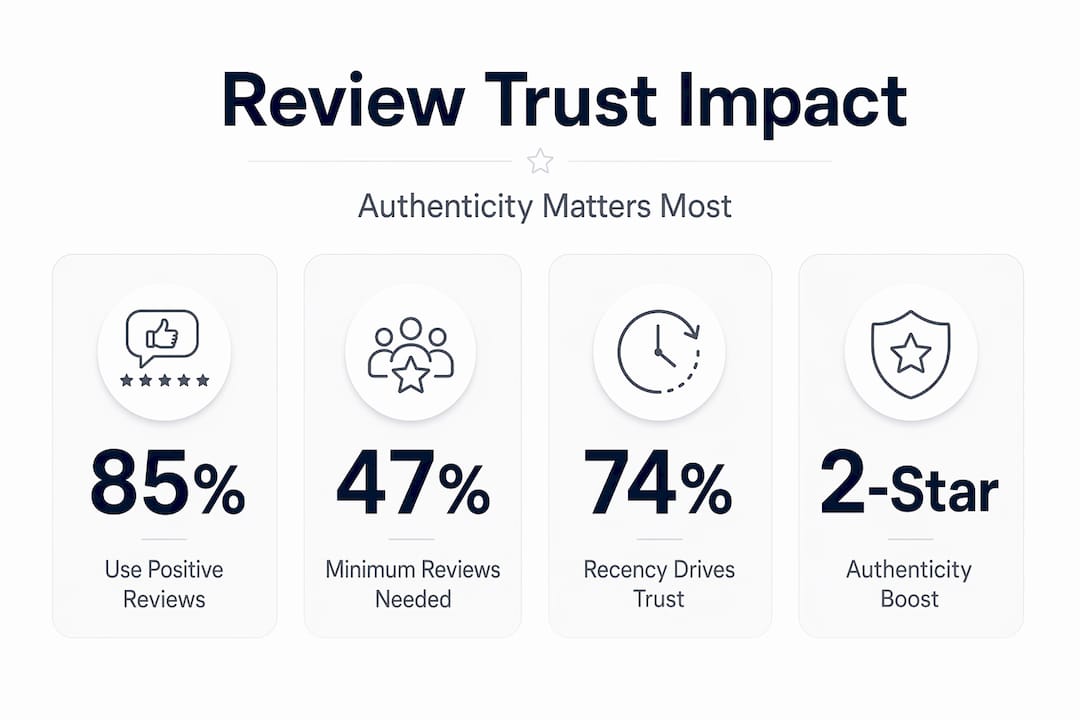
The numbers back this up clearly. Positive reviews increase the likelihood of a customer using your business by 85%, while negative reviews deter 77%. That is an enormous swing in either direction, driven entirely by what others say about you.
There are specific thresholds you need to meet before reviews even begin to work in your favour. Data shows 47% of consumers will not use a business with fewer than 20 reviews, and 31% require a minimum 4.5-star rating. Volume and quality both matter, and neither alone is sufficient.
One detail that many businesses overlook is the credibility of a perfect rating. A business with nothing but five-star reviews can actually appear suspicious to discerning buyers. Balanced reviews with owner responses signal genuine customer experience far more convincingly than a polished, uniform score. Responding to reviews publicly, including the occasional critical one, tells a visitor that there is a real, attentive team behind the business.
Pro Tip: Do not aim for perfection. Aim for authenticity. A well-handled two-star review with a thoughtful public response often builds more confidence than ten uncontested five-star ratings.
How reviews shape visitor behaviour
Understanding why website reviews matter means looking beyond trust and examining how reviews actively change what visitors do on your site. Reviews are not passive content. Placed correctly, they influence clicks, time on page, and the decisions visitors make before they ever contact you.
The most effective placement is not on a dedicated testimonials page that visitors have to seek out. It is on the pages where buying decisions are being made. Here is how to think about that strategically:
- Homepage placement introduces social proof within seconds of arrival, reassuring visitors who are still deciding whether to stay or leave.
- Service or product page placement provides specific evidence relevant to the exact thing a visitor is considering, at precisely the moment they are weighing it up.
- Checkout or contact page placement addresses last-minute hesitation, which is one of the most common reasons enquiries drop off.
- Review detail and imagery adds authenticity. A review with a customer’s name, location, and even a photo is significantly more persuasive than an anonymous quote.
- Owner responses visible on the page signal to new visitors that you take customer relationships seriously, which itself encourages enquiry.
Strategically displaying reviews on key pages encourages visitors to explore further and take action. The effect on conversion rates is measurable. Embedding reviews prominently can lift conversion rates by over 50%, according to research into review placement and social proof.
It is worth understanding that reviews rarely produce an instant sale. Most visitors who read a positive review will go on to research further before purchasing, checking other channels, comparing options, or returning later. Reviews support the wider decision journey. They are not a shortcut to immediate revenue. They are the foundation of confidence that eventually leads to it.

Pro Tip: If you are redesigning or refreshing your site, treat review placement as a structural decision rather than a finishing touch. Knowing how to design a business website that converts means building review visibility into the layout from the start.
The SEO advantages of website reviews
One of the less-discussed benefits of website reviews is what they contribute to your search engine visibility. Most business owners think of SEO as something that happens through blog posts, keywords, and technical optimisation. Reviews add a dimension that is difficult to replicate through any other means: continuous, authentic, user-generated content.
Here is a practical comparison of how reviews contribute to SEO relative to other content types:
| Content type | Freshness | Keyword richness | Authenticity signal | Frequency |
|---|---|---|---|---|
| Blog posts | Periodic | High (if planned) | Low (brand voice) | Low to moderate |
| Social media posts | Frequent | Variable | Moderate | High |
| Customer reviews | Ongoing | High (natural language) | Very high | Ongoing |
| Product/service pages | Infrequent | High (if optimised) | Low | Very low |
Reviews consistently produce natural-language content that mirrors how real people describe your services. That matters because search queries are written in natural language too. A customer who writes “brilliant local plumber, arrived on time and sorted the boiler within an hour” is inadvertently contributing keywords and phrases that match what future customers might actually search for.
Reviews also add fresh content that aids relevance, authority, and trust signals for search engines. For local businesses especially, a consistent volume of recent reviews across your website and platforms like Google reinforces your presence in location-based searches. Pairing this with a solid local SEO strategy amplifies those gains significantly.
Consistency across platforms matters here too. When your Google Business Profile, your website, and any sector-specific directories all show regular, positive reviews, search engines read that as a coherent and trustworthy digital footprint. That consistency strengthens your rankings over time.
Managing reviews effectively
Knowing why website reviews help is only part of the picture. The other part is building the habits and processes that keep your reviews working for you. This is where many small businesses fall short. They collect a batch of reviews during a busy period and then let them sit untouched for months. The result is a review display that looks outdated and gradually loses its persuasive power.
An effective review management approach covers several consistent practices:
- Request reviews regularly. Build it into your post-sale or post-service process. A simple follow-up message asking satisfied customers to leave a review is often enough. Timing matters. Ask when the experience is still fresh.
- Respond to every review. Positive or negative, a response demonstrates that your business is active and attentive. Responding to reviews publicly builds loyalty and shows prospective customers that they will be looked after.
- Keep your display current. An operational workflow for requesting, moderating, and updating reviews prevents the trust erosion that comes from stale content. If your most recent review is from 18 months ago, visitors will notice.
- Handle negative reviews constructively. A measured, professional response to a complaint can actually increase trust. It shows you take feedback seriously and are willing to put things right.
- Monitor multiple platforms. Your reputation exists on Google, sector-specific directories, and social media simultaneously. Keeping an eye on all of them is part of managing your online credibility. Connecting this to your broader digital outreach activity creates a more consistent brand presence across the web.
Pitfalls that undermine review effectiveness
There are a few common mistakes that quietly reduce the value of your reviews, even when you have put effort into collecting them.
The most damaging is allowing your review display to go stale. Research confirms that 74% of consumers only trust reviews from the last three months. If your newest review is older than that, a significant portion of your visitors will discount it entirely. Static displays do not build trust. They erode it.
Fake or excessively polished reviews carry a different kind of risk. Suspicious reviews can cause serious reputational and financial damage when consumers lose confidence in their authenticity. An all-five-star profile with no detail, no variation, and no owner engagement reads as manufactured. Consumers are increasingly good at spotting this.
Reviews alone do not guarantee conversions, either. They are part of a customer’s decision journey, not the whole of it. Expecting reviews to instantly generate sales can lead to misreading what is actually working in your marketing.
Pro Tip: Think of reviews as evidence, not advertising. The moment they start to look curated or controlled, they stop functioning as proof. Authenticity, including detailed review texts and owner engagement, is what makes them persuasive.
My take on why reviews are underestimated
I have worked with a lot of small businesses over the years, and the pattern I see most consistently is this: reviews are treated as a sign-off activity rather than a strategy. A business gets a decent set of reviews, puts them on the website, and considers the job done.
What I have found is that reviews, when actively managed, become a real source of competitive advantage. The businesses that stay on top of their review profiles, respond thoughtfully, and build collection into their regular workflow tend to pull ahead of competitors who are technically equal but passively managed. It is not glamorous work, but it compounds.
I also think there is a missed opportunity in how businesses use review feedback internally. The language customers use in their reviews often reveals what they value most, what caused hesitation, and where the experience could improve. That is useful intelligence. Treating reviews as a two-way channel rather than a one-way display changes how you engage with both existing and new customers.
The businesses I have seen grow most consistently from their online presence are the ones who treat reviews as an ongoing conversation, not a static badge.
— tibor
How Fyldedigital can help you make the most of reviews
If you have read this far, you already understand why website reviews matter and what good review management looks like. The next step is making sure your website is built to showcase them properly and that your wider digital presence reinforces the trust they create.

At Fyldedigital, we work with small and medium-sized businesses across Blackpool and the Fylde Coast to create websites that are designed around credibility and conversion from the ground up. Our web design services include strategic placement of reviews and testimonials as part of the layout, not as an afterthought. We also provide SEO strategies that build on user-generated content for rankings and local visibility. Whether you are starting from scratch or looking to improve what you already have, we can help you turn your reviews into a genuine business asset. Get in touch with Fyldedigital today for a free website review.
FAQ
Why use website reviews on your business site?
Website reviews provide social proof that builds trust with potential customers, supports your search rankings through fresh user-generated content, and increases the likelihood that visitors will make an enquiry or purchase.
How many reviews do you need before they become effective?
Research shows that 47% of consumers will not use a business with fewer than 20 reviews. Aim to reach that threshold as a baseline and then continue collecting consistently.
Do negative reviews damage your reputation?
Not necessarily. A negative review that receives a professional, constructive public response can actually increase trust by demonstrating that your business takes customer feedback seriously and acts on it.
How do website reviews help with SEO?
Reviews contribute continuous, natural-language content that search engines read as a relevance and trust signal, particularly for local search results. Combined with a local SEO strategy, they strengthen your overall digital footprint.
How often should you update or collect new reviews?
Continuously. Consumer trust in reviews drops sharply after three months, so an active, ongoing collection process is what keeps your review display persuasive and current.