Launching an online shop is one thing. Getting customers to actually find it is quite another. Many business owners invest heavily in building a beautiful ecommerce website, only to discover that it sits quietly in search results, invisible to the very people it was designed to serve. Ecommerce SEO, which stands for search engine optimisation tailored specifically to online retail, is the bridge between having a shop and running a successful one. This article explains what ecommerce SEO is, how its core components work, how it fits into your broader marketing strategy, and the practical steps you can take right now to start driving real, measurable results.
Table of Contents
- What is ecommerce SEO and why does it matter?
- Core components of ecommerce SEO
- How ecommerce SEO fits into your wider marketing strategy
- Practical steps: how to start optimising your ecommerce site
- Our experience: what most business owners miss about ecommerce SEO
- Get expert support for your ecommerce success
- Frequently asked questions
Key Takeaways
| Point | Details |
|---|---|
| Ecommerce SEO drives sales | Optimising for search engines increases online shop visibility and fuels revenue growth. |
| Core SEO pillars matter | Keyword targeting, technical health, and page quality deliver the best results for ecommerce websites. |
| Integrate with marketing | Ecommerce SEO works best alongside social media, PPC, and outreach for sustained growth. |
| Start with small actions | Consistent, focused improvements bring more progress than big, infrequent changes. |
| Professional support amplifies results | Expert web design and targeted SEO can multiply your online success and save time. |
What is ecommerce SEO and why does it matter?
Ecommerce SEO is the process of improving how your online shop appears in search engine results, so that more of your target customers find your products when they search for them. Standard SEO applies to all kinds of websites, from blogs to service pages. Ecommerce SEO goes further, focusing on product pages, category structures, filters, and the entire buying journey from the first search query to the completed sale.
SEO is essential for improving website visibility and driving organic traffic, and for an online shop this translates directly into potential revenue. When someone types “buy handmade leather wallet UK” into Google, the shops that appear on page one earn the clicks. Those further back rarely get a look in. If your products are not visible at that moment of intent, the sale goes elsewhere.
“Your website is often your first salesperson. If no one can find it through search, that salesperson never even gets through the door.”
The connection between search visibility and sales is not subtle. Research consistently shows that the vast majority of online shoppers begin their purchasing journey with a search engine query. That means your position in search results is one of the most powerful factors shaping how many people enter your shop at all.
Here is what makes ecommerce SEO distinct from general website SEO:
- Product page optimisation: Each product needs its own targeted content, not just a name and a price.
- Category page relevance: Category pages often rank for broader, high-volume keywords and drive significant traffic.
- Structured data: Markup that tells search engines about your product price, availability, and reviews.
- Duplicate content management: Ecommerce sites frequently generate duplicate pages through filters, variations, and pagination.
- Crawl efficiency: Large catalogues need careful technical management so search engines can index every important page.
Pro Tip: Generic SEO advice often focuses on blog content and homepage rankings. Ecommerce SEO must also cover product and category pages, which is where the actual buying intent lives.
Core components of ecommerce SEO
Now that you know why ecommerce SEO matters, let us break down the key components so you can focus your efforts where they count most.
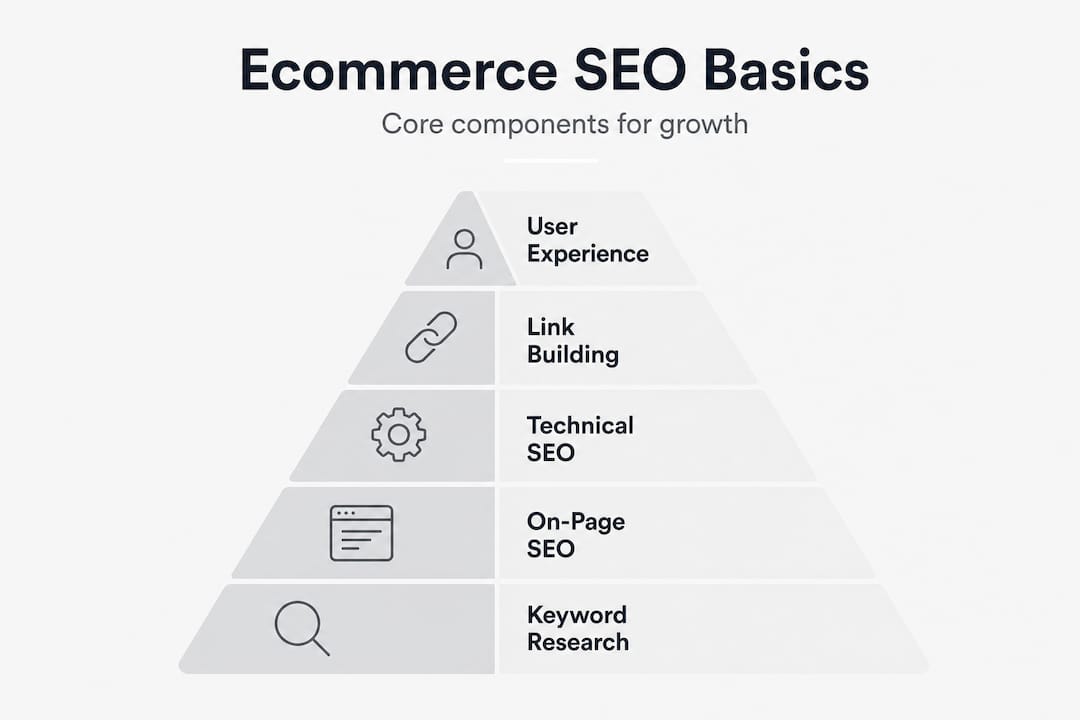
SEO strategies include keyword research, technical optimisation, and enhancing user experience, and for ecommerce businesses these three pillars are the foundation on which everything else is built. Let us look at each in detail.
1. Keyword research and targeting
This is where every good ecommerce SEO effort starts. You need to understand precisely what phrases your potential customers use when they are ready to buy, not just browse. Tools like Google’s Keyword Planner can reveal whether people search for “women’s running shoes size 7” or “ladies trainers for road running.” These distinctions matter enormously for how you write product titles and descriptions.
2. On-page SEO for product and category pages
Every product page should have a unique title tag, a compelling meta description, and a well-written product description that naturally includes relevant keywords. Think of the meta description as a mini-advertisement in search results. A generic description like “Blue Jacket, 100% cotton” will not entice a click nearly as well as “Lightweight, machine-washable blue jacket perfect for unpredictable British weather.”

3. Technical SEO
This covers the behind-the-scenes health of your website. Site speed is critical because slow pages lose both visitors and search rankings. Mobile friendliness is non-negotiable since most online shopping now happens on smartphones. Site structure, which is how your pages link together, affects how easily search engines crawl and understand your catalogue. If you are considering a redesign, reviewing website redesign and SEO considerations early can save considerable time and effort later.
4. Link building and domain authority
Backlinks, which are links pointing to your site from other reputable websites, are a signal to search engines that your shop is trustworthy and relevant. A local business directory listing, a feature in a regional publication, or a mention from an industry blog all contribute to this. Building authority takes time, but it pays off steadily.
5. User experience and conversion optimisation
SEO brings visitors in. User experience (UX) decides whether they buy. Clear navigation, fast loading pages, trustworthy product images, and a smooth checkout process all contribute. If you are unsure of the marketing terminology around UX and conversion, getting familiar with these concepts will help you make better decisions for your shop.
| SEO component | What it involves | Business value |
|---|---|---|
| Keyword research | Identifying what shoppers search for | Drives relevant, ready-to-buy traffic |
| On-page optimisation | Product titles, descriptions, meta tags | Higher rankings and better click rates |
| Technical SEO | Speed, mobile, site structure | Ensures search engines can index your shop |
| Link building | Earning backlinks from reputable sites | Builds trust and authority over time |
| User experience | Navigation, design, checkout flow | Converts visitors into paying customers |
Pro Tip: Fix your technical SEO first before investing in link building. A slow, poorly structured site wastes the authority that backlinks provide.
How ecommerce SEO fits into your wider marketing strategy
Understanding core SEO components is important, but integrating them with your overall marketing unlocks much greater value. Successful online businesses integrate SEO with other digital marketing channels for maximum results, and there are strong practical reasons for this.
SEO, PPC (pay-per-click advertising), social media, and digital outreach strategies each serve different purposes and reach customers at different stages of the buying journey. SEO tends to attract people who are actively searching, which makes it highly valuable for intent-driven traffic. PPC gives you instant visibility for competitive terms, but requires ongoing budget. Social media builds awareness and repeat engagement, but rarely converts strangers into buyers at the same rate as search.
Here is how the channels compare:
| Channel | Strengths | Limitations |
|---|---|---|
| Ecommerce SEO | Long-term, cost-effective, intent-driven | Takes time to build momentum |
| PPC advertising | Immediate visibility, measurable ROI | Stops when budget runs out |
| Social media | Brand awareness, community building | Lower purchase intent from cold audiences |
| Email marketing | High ROI, loyal audience engagement | Requires existing list to be effective |
The smart approach is to use each channel’s strengths together. Your SEO keyword data, for example, tells you exactly what language your customers use. You can feed that directly into your PPC ad copy, your social media posts, and your email subject lines. This makes every channel more effective without extra research.
Consider these integration tactics:
- Use your best-performing organic search keywords as the basis for PPC campaigns during seasonal peaks.
- Share optimised product page content across social channels to drive referral traffic.
- Use blog content that ranks in search to build your email subscriber list through relevant lead magnets.
- Analyse which landing pages convert best from organic search, then replicate that structure across paid campaigns.
Pro Tip: Your SEO analytics are a goldmine for other channels. The keywords that bring organic buyers to your site tell you exactly what your audience cares about. Use that data everywhere.
You can explore more about joining these efforts together through Fylde Digital’s digital marketing hub and take a closer look at available business digital services to see how each piece can work together.
Practical steps: how to start optimising your ecommerce site
With the strategy in mind, here is how you can take practical action and kick-start your ecommerce SEO journey. Implementing SEO best practices drives lasting business growth, and the good news is that you do not need to overhaul everything at once.
-
Audit your current site: Use a free tool such as Google Search Console to see which pages are indexed, which have errors, and where your current traffic comes from. This gives you a clear starting point rather than guessing.
-
Research your product keywords: Think about the words your customers use, not the internal jargon your industry favours. A customer searching for “non-slip bath mat” is using buyer language. Make sure your product titles and descriptions reflect this naturally.
-
Optimise your product pages: Rewrite thin or duplicate product descriptions. Add unique, descriptive titles. Write meta descriptions that include a benefit or differentiator, not just the product name. Add alt text to all product images, describing what is shown clearly and concisely.
-
Improve your site speed and mobile experience: Use Google’s free PageSpeed Insights tool to identify what is slowing your site down. Common culprits include uncompressed images, too many third-party scripts, and slow hosting. A mobile-first experience is no longer optional because most of your visitors are on their phones.
-
Build quality backlinks: Reach out to local directories, trade publications, and complementary businesses. Guest articles on relevant blogs, supplier mentions, and PR activity all contribute. Quality beats quantity here. One link from a respected industry site is worth far more than twenty links from low-quality directories.
-
Monitor your progress consistently: Set up monthly reporting on keyword rankings, organic traffic, and conversion rates from search. Progress is sometimes slow at first, but tracking keeps you informed and helps you prioritise where to focus next. Both effective SEO strategies and your website redesign and SEO approach should feed into this ongoing review.
Pro Tip: Small, consistent improvements compound over time. Updating ten product descriptions a week is more effective than a one-off overhaul followed by months of inaction.
Our experience: what most business owners miss about ecommerce SEO
Working with ecommerce businesses across a range of sectors, we have noticed a pattern that holds almost universally. Business owners understand that SEO matters. They just tend to underestimate how much sustained effort it requires before results become visible.
Most expect a significant uplift within weeks of making changes. The reality is closer to three to six months before rankings move meaningfully, and longer still before those rankings translate into a notable change in revenue. This is not a flaw in SEO. It is how trust works. Search engines are essentially deciding which shops they can confidently recommend to their users. That confidence is earned, not bought overnight.
Generic SEO advice also causes real problems for ecommerce businesses. A strategy built around blog posts and homepage authority is a poor fit for a shop with five hundred product pages and ten category pages. The leverage points are completely different. Ecommerce SEO wins are found in product page structure, internal linking between related products, and fixing technical issues that prevent proper indexing, not in churning out weekly blog content that nobody searches for.
The most contrarian thing we would tell any online retailer is this: focus on your site structure before you focus on content or links. We have seen shops where simply reorganising the category hierarchy and fixing duplicate URL issues led to a meaningful improvement in rankings, without adding a single new page. Structure is the scaffolding everything else depends on.
We have also seen businesses try to shortcut the process by chasing quick wins like link schemes or keyword stuffing. These tactics either fail to work or, worse, result in penalties that take months to recover from. The comparison between SEO vs PPC for growth is a useful lens here. PPC can give you immediate results with immediate spend. SEO is the long game, and the returns compound when you play it properly.
Investing in well-structured content, a clean layout, and logical navigation is not glamorous work. But in our experience, it consistently outperforms any shortcut strategy over a twelve month period.
Get expert support for your ecommerce success
Getting your ecommerce SEO right takes time, knowledge, and consistent effort. The good news is that you do not have to navigate it alone.

At Fylde Digital, we work with small and medium-sized businesses to build ecommerce visibility that actually drives sales. From web design for ecommerce built with search performance in mind, to targeted SEO services Blackpool and beyond, our team combines technical expertise with a clear focus on your business outcomes. We tailor every strategy to your products, your market, and your goals, so you are not getting generic advice but a plan built specifically for your shop. Get in touch today for a no-obligation consultation and find out how our SEO best practices approach can start working for your business.
Frequently asked questions
How does ecommerce SEO differ from standard website SEO?
Ecommerce SEO focuses specifically on product pages, category structures, and driving purchase intent rather than general informational content, requiring a distinct approach to keyword research and technical optimisation that standard website SEO rarely addresses in depth.
How long does it take to see results from ecommerce SEO?
Most businesses begin to see measurable improvements within three to six months, though this depends on the level of competition in your market and the consistency of your efforts. Implementing SEO best practices steadily and correctly accelerates that timeline.
Can SEO help a small business compete with big online retailers?
Yes, absolutely. Ecommerce SEO allows small businesses to rank for specific niche and long-tail keywords that large retailers often overlook, and improving website visibility in targeted searches can bring highly relevant, purchase-ready customers directly to your shop.
What is the most important factor for ecommerce SEO success?
A well-structured site with clearly optimised product pages forms the foundation, and consistent technical optimisation combined with regular improvement across your catalogue is what separates shops that grow from those that stagnate.