Choose holistic marketing because it turns disconnected touchpoints into one trust-building customer experience, and that consistency is exactly what AI-driven discovery tools now reward. Philip Kotler built the framework decades ago, but Harvard Business Review’s thinking on marketing’s enterprise-wide role has never mattered more. Research shows 44.2% of AI citations come from content that reads as coherent and well-structured. Fragmented marketing simply doesn’t surface as often in tools like ChatGPT or Google’s AI Overviews.
For a small or medium-sized business, the immediate gains look like this:
- Stronger brand trust from consistent messaging across every channel
- Better resilience when search algorithms or AI discovery patterns shift
- Tighter employee alignment, because everyone is selling the same story
Key Takeaways
Holistic marketing works because it aligns internal teams, integrated channels and customer relationships around one consistent brand story, which AI-driven discovery tools increasingly reward.
| Point | Details |
|---|---|
| Start with one dimension | Pilot internal or integrated marketing first to prove value before a full rollout. |
| Track mixed KPIs | Pair short-term signals like conversion rate with long-term ones like retention. |
| Expect 6 to 12 months | Meaningful retention and conversion gains typically compound over that window. |
| Use a small case to build buy-in | A tight pilot, like a local sustainability pledge, proves the approach cheaply. |
| Fylde Digital supports rollout | Web design, SEO, PPC and social services under one team keep messaging consistent. |
Table of Contents
- Why choose holistic marketing over a siloed approach?
- What are the benefits of holistic marketing for SMEs?
- What are Kotler’s four dimensions of holistic marketing?
- How do you implement holistic marketing step by step?
- How do you measure whether holistic marketing is working?
- Is holistic marketing worth the cost and effort for a small business?
- What does societal marketing look like for a small producer?
- Why start building holistic marketing now?
- How Fylde Digital helps you bring holistic marketing to life
- Sources
Why choose holistic marketing over a siloed approach?
Holistic marketing treats every customer touchpoint, product experience, sales conversation and support ticket as part of one connected brand story, rather than a series of separate campaigns run by separate teams. That’s the working definition worth keeping in mind for the rest of this guide.
Traditional marketing tends to operate campaign by campaign: a paid search push here, a social media burst there, a print leaflet drop somewhere else, often with little communication between the people running each one. Holistic marketing asks a different question. Instead of “how do we get more clicks this month,” it asks “does everything we put in front of a customer feel like it comes from the same business.”
Kotler’s influence runs through this shift, and HBR’s enterprise framing backs it up: marketing isn’t a department’s job anymore, it’s a company-wide discipline.
- Traditional: campaign-first, channel-siloed, inconsistent tone
- Holistic: strategy-first, cross-departmental, one coherent voice
Pro Tip: Read your last five customer-facing emails, ads and social posts back to back. If they don’t sound like the same business wrote them, you’ve found your starting point.
What are the benefits of holistic marketing for SMEs?
The advantages of holistic marketing aren’t abstract. They show up in numbers you already track.
- Higher customer lifetime value, because consistent experiences build repeat trust rather than one-off transactions
- Better return on ad spend, since campaigns reinforce each other instead of competing for attention
- Stronger retention, because support and sales stop contradicting what marketing promised
- Less duplicate spend across channels, when teams stop rebuilding the same assets in isolation
There’s a 2026-specific benefit too. Consistent, well-structured information across the web is more likely to be surfaced by AI search tools, which means businesses with disjointed content risk becoming invisible exactly when discovery habits are changing fastest.
In a fragmented attention economy, businesses with consistent messaging keep more prospects through the research phase. Incoherent brand signals raise bounce rates and quietly erode conversions before a prospect ever reaches a sales conversation.
None of this requires an enterprise budget. Small businesses can align marketing, sales and support around shared data and goals using tools most SMEs already have. The employee alignment angle matters too: when sales, support and marketing tell the same story, internal friction drops, and fewer customers hear conflicting messages from different departments.
What are Kotler’s four dimensions of holistic marketing?
Kotler’s framework breaks holistic marketing into four dimensions, and understanding each one tells you where to focus first.
- Internal marketing: getting your own staff to believe and communicate the brand consistently
- Integrated marketing: making sure every channel, from your website to your SEO, PPC and social activity, works from the same playbook
- Relationship marketing: building loyalty through customers, partners and suppliers, not just transactions
- Performance and societal marketing: measuring commercial results alongside your wider impact
Most SMEs should start with internal marketing or integrated marketing, since both are low-cost and expose quick wins fast. Relationship and societal marketing tend to compound once the basics are aligned.
Ben & Jerry’s remains the textbook example of societal marketing done at scale, weaving environmental and social causes into product decisions and advertising without sacrificing commercial performance. The principle scales down: purpose and profit aren’t opposites when they’re built into the same campaign.
Pro Tip: Run a four-week pilot in one dimension before pitching a full rollout to leadership. A small, measurable win earns budget faster than a strategy deck ever will.
How do you implement holistic marketing step by step?
A practical rollout for an SME team looks like this:
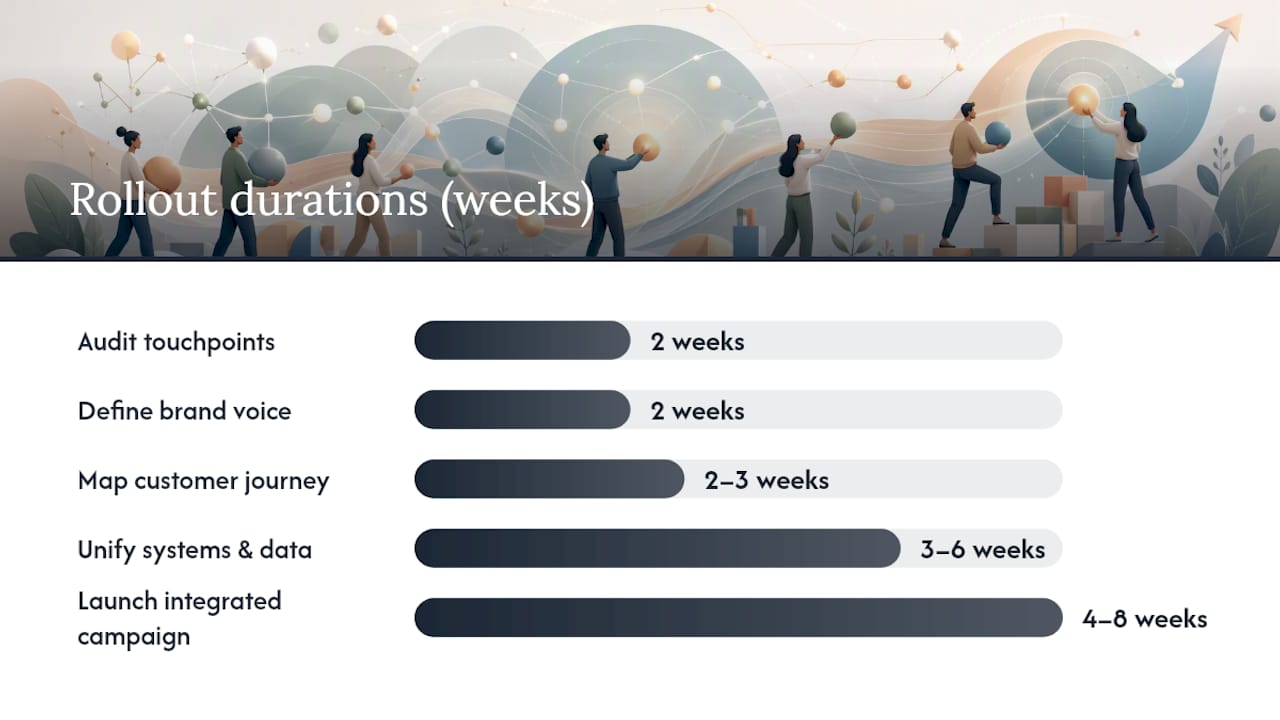
- Audit your current touchpoints (2 weeks). List every channel, asset and message currently live, and flag inconsistencies.
- Define your brand voice and promise (2 weeks). One paragraph that describes how your business should sound everywhere, agreed by leadership.
- Map the customer journey (2 to 3 weeks). Trace how a prospect actually moves from discovery to purchase to support.
- Unify systems and data (3 to 6 weeks). Connect your CRM, analytics and content calendars so teams see the same numbers.
- Build cross-team workflows (2 weeks). Set a recurring meeting between marketing, sales and support to review messaging.
- Launch integrated campaigns (4 to 8 weeks). Coordinate one campaign across web, PPC, social and email rather than running them separately.
- Measure and iterate continuously (ongoing). Track the KPIs from the next section and adjust monthly.
You need at minimum a marketing lead, someone with sales or support visibility, and one person with authority over your website and analytics. Three people can run this; you don’t need a department.
Quick wins matter more than perfection here. A single pilot, such as unifying your website messaging with your social bios for one month, proves the approach before you commit a full budget to it.
How do you measure whether holistic marketing is working?
Track a mix of commercial and brand metrics, because holistic marketing succeeds or fails on both fronts. Combining traditional digital KPIs with brand and retention metrics is the only way to see the full picture.
- Customer lifetime value, tracked quarterly against your baseline
- Retention rate, month on month
- Net Promoter Score, surveyed after key interactions
- Cross-channel conversion rate, comparing coordinated campaigns against isolated ones
- Brand trust indicators, such as repeat visits or direct traffic growth
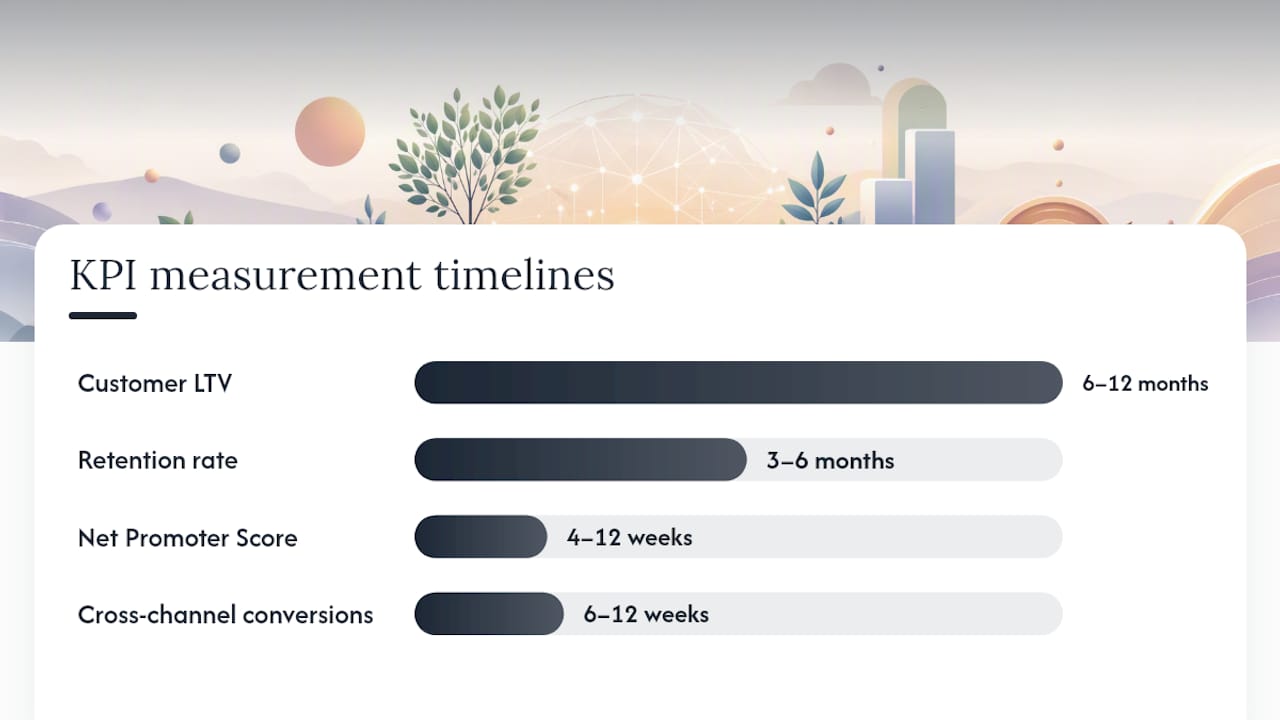
Early signals arrive in 4 to 12 weeks. Meaningful shifts in retention and conversion tend to show up between 6 and 12 months. The compounding gains, where brand trust starts reducing acquisition costs, usually take 12 months or more.
| KPI | What to measure | Typical SME timeline |
|---|---|---|
| Customer lifetime value | Average revenue per customer over time | 6 to 12 months |
| Retention rate | Percentage of repeat customers | 3 to 6 months |
| Net Promoter Score | Post-interaction customer surveys | 4 to 12 weeks |
| Cross-channel conversion rate | Conversions from coordinated vs. siloed campaigns | 6 to 12 weeks |
Investment scales with ambition. Basic co-ordination, tightening messaging across existing channels, can often be handled internally or with light agency support. A full platform overhaul with retained SEO and social management involves a larger ongoing retainer, priced against the size of your channel mix rather than a flat fee.
Is holistic marketing worth the cost and effort for a small business?
The objections are predictable, and most have a straightforward answer.
- “It’s too expensive.” Start with a phased pilot in one dimension rather than a full rebuild.
- “We need quick leads, not a strategy.” Run short-term paid tactics alongside the long-term programme, not instead of it.
- “It’s hard to measure.” Pair immediate KPIs like conversion rate with medium-term ones like retention, so early wins are visible.
- “Leadership isn’t convinced.” Bring a one-page briefing with the pilot’s results rather than a theoretical case.
One objection is genuinely valid: this isn’t a quick fix. Holistic marketing rewards patience, and businesses expecting overnight results in a fortnight will be disappointed.
What does societal marketing look like for a small producer?
Ben & Jerry’s built its identity on causes woven directly into products and advertising, proving purpose and commercial performance can reinforce each other at scale.
A smaller version might look like this: a local food producer pledges to source ingredients within 50 miles and promotes that pledge consistently across packaging, social media and its website, rather than as a one-off press release.
- The pledge appeared on every channel, not just one campaign
- Local press picked up the story unprompted, and repeat purchases rose in the following quarter
The mechanism is the same as Ben & Jerry’s, just at a scale any SME could replicate this year.
Why start building holistic marketing now?
AI-driven discovery is rewarding cohesion faster than most SME leadership teams realise, and the businesses that wait tend to find the gap harder to close later, not easier. Compounding brand trust doesn’t arrive on demand. It builds from consistent decisions made months before you need the payoff.
If you’re weighing where to start, a short review of your current channels usually reveals more than a strategy workshop would.
How Fylde Digital helps you bring holistic marketing to life
Fylde Digital is the practical alternative to hiring separate freelancers for your website, SEO and social media, because one team keeps your brand voice consistent across every channel instead of stitching together mismatched work after the fact. We handle web design, integrated SEO, PPC, social media management and print collateral under one roof, so the pilot described above doesn’t stall on handoffs between suppliers.
Whether you’re auditing your current touchpoints or ready to unify your messaging across channels, our SEO strategy guidance gives you a practical next step. Request a free website and SEO review to see exactly where your current setup breaks the holistic model, and where the quickest wins are.
Sources
- What holistic marketing is — and how can it be applied to business?
- Holistic Marketing Strategy for Small Businesses
- Holistic marketing strategies: drive business growth